Durban, KwaZulu-Natal, South Africa · South African (Durban Indian)
Bunny Chow (Durban Lamb Curry in a Bread Loaf)
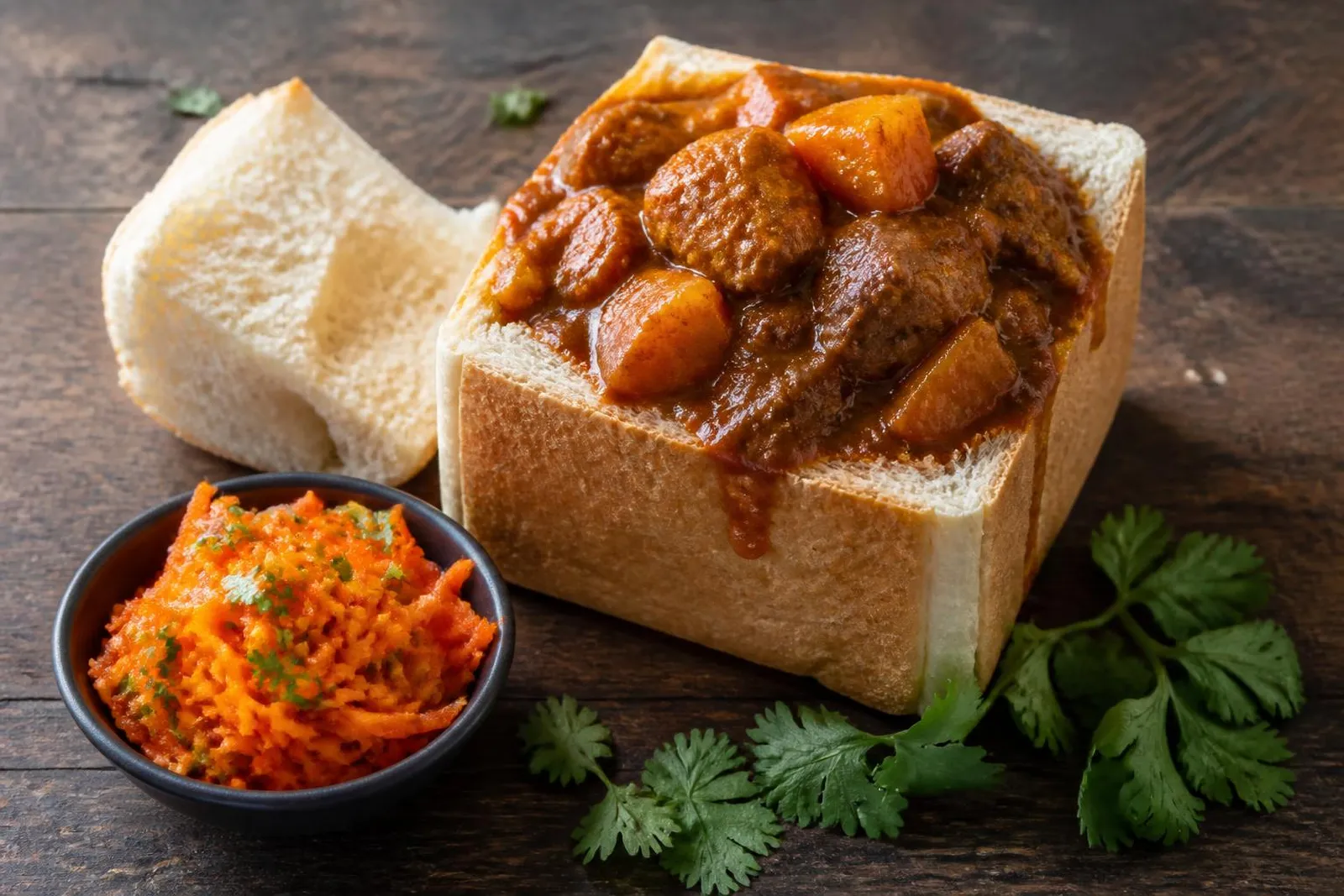
A quarter-loaf of hollowed white bread brimming with fiery Durban lamb curry — South Africa's most iconic street food, born from the Indian community of KwaZulu-Natal. No cutlery required; the bread is the bowl.
Published September 25, 2026
Cultural context
Durban has the largest Indian population outside India itself, descended from indentured labourers brought to Natal's sugar estates from the 1860s and from free 'passenger' merchants who followed. Bunny chow grew out of that community sometime in the 1940s–50s — a hollowed loaf built to carry curry to workers with no time or table to sit at. The exact inventor is disputed and probably unknowable; what's certain is that it's a Durban Indian dish through and through, not a South African dish in general.
Bunny chow is Durban’s great contribution to world food: a quarter- or half-loaf of white bread, hollowed out and filled to the brim with a fiery lamb curry, eaten entirely by hand. It looks like a novelty and eats like one of the most satisfying one-dish meals anywhere — the bread lid doubles as a spoon, the base soaks up every drop of gravy, and there’s no plate to wash.
Born in Durban’s Indian kitchens
Durban is home to the largest Indian population outside India, the legacy of indentured labourers shipped to Natal’s sugar estates from 1860 onward, and the free “passenger” traders who arrived alongside and after them. Out of that community’s tea rooms and curry houses, sometime in the 1940s or ’50s, came bunny chow — most likely built as a portable, cutlery-free lunch for workers with nowhere to sit down and eat. Exactly who first hollowed a loaf and ladled curry into it is genuinely disputed, and probably always will be; what isn’t in question is that this is a Durban Indian dish, distinct from South African cuisine more broadly.
Why the gravy has to be thick
A soupy curry turns the bread to paste before you’ve had three bites. Durban curry houses solve this two ways: cooking the tomato-onion masala down hard before the meat goes in, and letting the potatoes break down slightly as they simmer, which thickens the gravy from within. The result should be substantial enough to hold its shape on a spoon — or, more to the point, on a torn piece of bread.
Meat, beans, or both
Long before meat bunny chow became the dish tourists photograph, bean bunny chow — a slow-cooked sugar bean curry — was the everyday version in Durban’s Indian households, cheaper and just as beloved. Lamb and mutton versions became the curry-house showcase, and chicken is the newer, milder arrival most commonly ordered today. All three are legitimate; this recipe uses lamb because it’s the version most associated with the dish’s reputation for serious heat and body.
Eating it right
Skip the cutlery. Tear a piece off the bread lid, scoop up curry and meat, and work your way down to the gravy-soaked base — the best part, by Durban consensus. A bowl of quick-pickled carrot sambal on the side cuts the richness between bites. For another dish that turns a hollowed carb into the main event, try Bobotie, South Africa’s spiced, egg-topped mince bake, or Peri-Peri Chicken for the Mozambican-Portuguese chile heat that runs through so much of southern African cooking. More context on dishes like this one lives in the World Classics guide.
Ingredients
For the curry base
- 6 large cloves garlic Blitzed with the ginger into a rough paste.
- 1 (3-inch) piece fresh ginger
For the curry
- 1/4 cup neutral oil (sunflower or canola)
- 2 large onions, finely chopped
- 4 bay leaves
- 2 small sticks cinnamon
- 1 tbsp ground turmeric
- 3 tbsp curry powder (Durban-style masala) A hot, cumin- and coriander-forward blend — Rajah brand is the Durban standby. Mild Madras-style curry powder plus an extra 1/2 tsp cayenne gets you close.
- 1 tsp garam masala
- 1/2–1 tsp Kashmiri chile powder For colour and a milder heat than cayenne; use more or less to taste. Durban curry is meant to bite back — don't be shy.
- 3 medium tomatoes, chopped
- 2 lb (900 g) bone-in mutton or lamb shoulder, cut into 1.5-inch pieces Bone-in gives the gravy body. Goat works too and is closer to what's used back in KwaZulu-Natal.
- 2 medium potatoes, peeled and cut into large chunks They break down slightly and thicken the gravy — a Durban curry-house signature.
- 2 cups water or stock
- 2 tsp kosher salt, or to taste
For the carrot sambal (the classic side)
- 3 carrots, coarsely grated
- 1 tsp black or brown mustard seeds
- 1 tbsp oil
- 1 tbsp white vinegar or lemon juice
- 1 green chile, finely chopped Optional, for heat.
- 1/2 tsp sugar, plus salt to taste
To serve
- 1 (1 lb) loaf unsliced white sandwich bread It has to be sturdy, plain white bread — a rustic artisan loaf or sliced sandwich bread both fall apart. This is the one dish where cheap bread is correct.
- fresh cilantro leaves and lemon wedges, to finish
Method
Tap a step’s number to check it off as you go.
-
Blitz the garlic and ginger with a splash of water into a rough paste.
Why: A paste (rather than mincing) distributes evenly through the gravy instead of leaving hot pockets of raw garlic.
-
Heat the oil in a heavy pot over medium heat. Fry the onions with the bay leaves and cinnamon stick for 6–8 minutes, until soft and golden.
Why: This is the base every Durban curry builds on — take the onions past translucent into real colour, or the curry tastes thin.
-
Stir in the turmeric, curry powder, garam masala and chile powder along with the garlic-ginger paste. Cook for 30–60 seconds, stirring constantly, until fragrant.
Why: Dry spices scorch fast once the raw onion moisture cooks off — this step is measured in seconds, not minutes, so keep it moving.
-
Add the tomatoes and cook, mashing them down, for 4–5 minutes until they collapse into the spice base.
Why: The tomatoes need to break down completely and the oil should start separating at the edges — that's the sign the masala is actually cooked, not just simmered.
-
Add the lamb and salt, stir to coat in the masala, and cook for 10 minutes, until the meat firms up and takes on colour.
-
Add the potatoes and water, bring to a boil, then cover and simmer on low for 45–55 minutes, until the lamb is fork-tender and the gravy has thickened.
Why: Durban bunny chow gravy is meant to be thick enough to scoop with bread, not brothy — the potatoes breaking down slightly is what gets you there. Uncover for the last 10 minutes if it's still loose.
-
Meanwhile, make the carrot sambal: toast the mustard seeds in the oil until they pop, then toss with the grated carrot, vinegar, chile, sugar and salt. Set aside to marinate.
Why: This bright, quick-pickled salad is the traditional foil to the rich curry — Durban curry houses serve it alongside almost everything.
-
Cut the bread loaf into quarters. Working from the top of each quarter, hollow out most of the interior, leaving a ¾-inch wall and the base intact, and reserve the bread you remove.
Why: The hollowed loaf is the whole point of the dish — it's the bowl, the plate and the last course, once the gravy has soaked through it.
-
Spoon the hot curry into the bread bowls, piling it well above the rim. Serve immediately with the reserved bread pieces, the carrot sambal, cilantro and lemon wedges.
Why: Bunny chow is eaten by hand, no cutlery — you tear the bread and use it to scoop, saving the curry-soaked base for last. Let it sit even five minutes too long and the bread turns to mush, so this is a serve-it-now dish.
A quick, anonymous tap — no review needed.
Variations
- Bean bunny chow (vegetarian)
Swap the lamb for 2 cans of drained sugar beans or pinto beans, added in the last 15 minutes instead of simmering for an hour — this is actually the older, more everyday version, a working-class staple long before meat bunny chow became the tourist favourite.
- Chicken bunny chow
Use bone-in chicken thighs instead of lamb and cut the simmer to 25–30 minutes. Milder and faster — the modern, most commonly ordered version at Durban takeaways today.
- Durban fire
Add 2–3 chopped bird's eye chiles with the tomatoes for the eye-watering heat serious Durban curry houses are famous for.
Serving & Storage
Eat it the Durban way: no plate, no cutlery, tear off pieces of the bread lid to scoop the gravy, and keep the carrot sambal close by to cut the richness between bites.
Pairs with: Carrot sambal, Sliced tomato and onion salad, Mango atchar (pickle), Ginger beer.
Storage: The curry improves overnight and keeps refrigerated for up to 3 days, or freezes for up to 2 months. Reheat the curry fully before hollowing fresh bread to order — a soggy bread bowl doesn't reheat well, so always assemble just before serving.
Nutrition
Per serving (1 quarter-loaf with curry)
- Calories
- 640
- Protein
- 34 g
- Carbs
- 62 g
- Fat
- 28 g
- Fiber
- 5 g
- Sugar
- 9 g
- Sodium
- 980 mg
Notable micronutrients: Iron, Vitamin A, Vitamin C
Estimated using standard ingredient data. Values vary with brands and substitutions.
Frequently Asked Questions
Is bunny chow made with meat or beans?
Both are authentic. Bean bunny chow — a hearty sugar-bean curry — was the everyday, budget version many working-class Durban Indian families grew up on, while mutton or lamb bunny chow became the dish's showcase version at curry houses. Chicken bunny chow is a newer, milder addition that's now the most commonly ordered option.
Why is it called 'bunny' chow — is there rabbit in it?
No rabbit at all. The name's origin is disputed: the leading theory traces 'bunny' to 'bania,' a Gujarati merchant caste, since bania-run eateries are thought to have popularized the dish; other stories point to sugarcane workers or golf caddies needing a cutlery-free lunch. Nobody agrees on the exact inventor, but everyone agrees it's Durban's dish.
What bread actually works for this?
A plain, sturdy unsliced white loaf — the same kind sold as a basic sandwich loaf. It needs to hold its shape once hollowed and to soak up gravy without disintegrating; a crusty artisan loaf is too hard to hollow and too tough to eat by hand.
What to drink with this
All drinks →Hand-picked pours to match this dish. Alcoholic pairings are for adults of legal drinking age (21+ in the US) — please drink responsibly.
 21+
Bermuda · Bermudian
Dark 'n' Stormy (Dark Rum & Ginger Beer)
Bermuda's national drink and a two-ingredient masterclass — spicy ginger beer poured tall, then dark rum floated on top so it rolls through like a storm cloud. Fresh lime, the right rum, and why the float matters.

Jamaica & the Caribbean; England · Caribbean / British
Ginger Beer (Homemade, Fiery & Non-Alcoholic)
Fresh ginger, lime and sugar carbonated into a spicy, bracing brew — the real thing, far hotter than anything bottled. A Caribbean and British favourite that's the backbone of the Moscow Mule and Dark 'n' Stormy, and a sensational soda on its own.
 21+
Ireland by way of the American mule craze · Irish
Irish Mule (Irish Whiskey, Lime & Ginger Beer)
The mule in a green sweater: smooth Irish whiskey in place of vodka, fresh lime and spicy ginger beer over ice. Light, honeyed and gently spiced — a two-minute copper-mug cooler with an easy Irish charm.
From our kitchen community
Ratings & Reviews
My Rating
Tap a star to rate — no sign-in, no form needed.
My Review
0 Ratings
🥣 0 home cooks made it!
Be the first to rate Bunny Chow (Durban Lamb Curry in a Bread Loaf).
Related Recipes

Cape Town and the Western Cape — the Cape Malay kitchens of the Bo-Kaap and the wider Cape · South African
Bobotie — Cape Malay Curried Mince with a Golden Egg Custard
South Africa's great baked dish: mildly curried mince sweetened with dried fruit, bound with milk-soaked bread, and finished under a thin turmeric-yellow custard with bay leaves standing in it. The two things that decide the outcome are the soaked bread and a loosely levelled top.

The Mozambican coast and the Zambezi delta — Maputo, Quelimane and Ilha de Moçambique — with a parallel life in Angola, in South Africa, and in the churrasqueiras of Portugal's Algarve · Mozambican
Peri-Peri Chicken — Frango Piri-Piri, the Chilli That Sailed Both Ways
A butterflied chicken lacquered in African bird's eye chilli, garlic, lemon and paprika, grilled over coals and basted until the skin is scarlet and blistered. The dish belongs to Mozambique, Angola, Portugal and South Africa at once — here is the version they'd all recognise, and why the baste matters more than the marinade.
Kashmir / North India · Indian
Kashmiri Rogan Josh (Aromatic Red Lamb Curry)
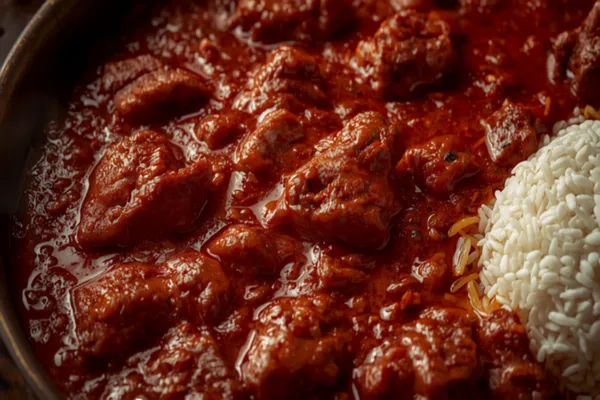
The Kashmiri Wazwan classic: lamb slow-cooked in a brick-red gravy coloured by Kashmiri chilies and ratan jot, perfumed with fennel, ginger powder, and warm spices — and, in the Pandit style, no onion or garlic. Aromatic, not fiery.
The Ethiopian highlands — Amhara and Addis Ababa, shared across the Horn of Africa · Ethiopian
Doro Wat (Ethiopian Spiced Chicken Stew)
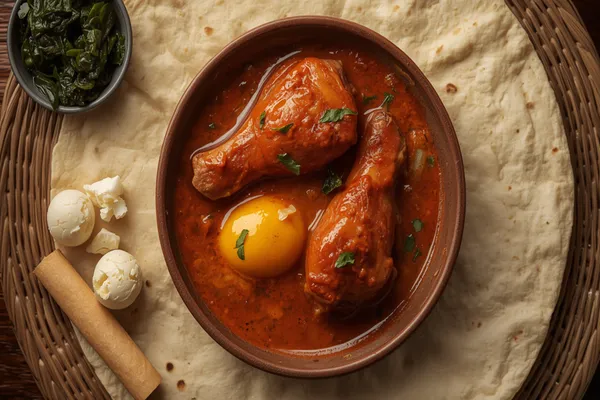
Ethiopia's feast-day chicken stew, built the slow way: a kilo of onions dry-cooked to a purée before any fat touches the pan, berbere and spiced butter bloomed into them, and chicken and whole eggs simmered until the sauce turns mahogany.