The Ethiopian highlands — Amhara and Addis Ababa, shared across the Horn of Africa · Ethiopian
Doro Wat (Ethiopian Spiced Chicken Stew)
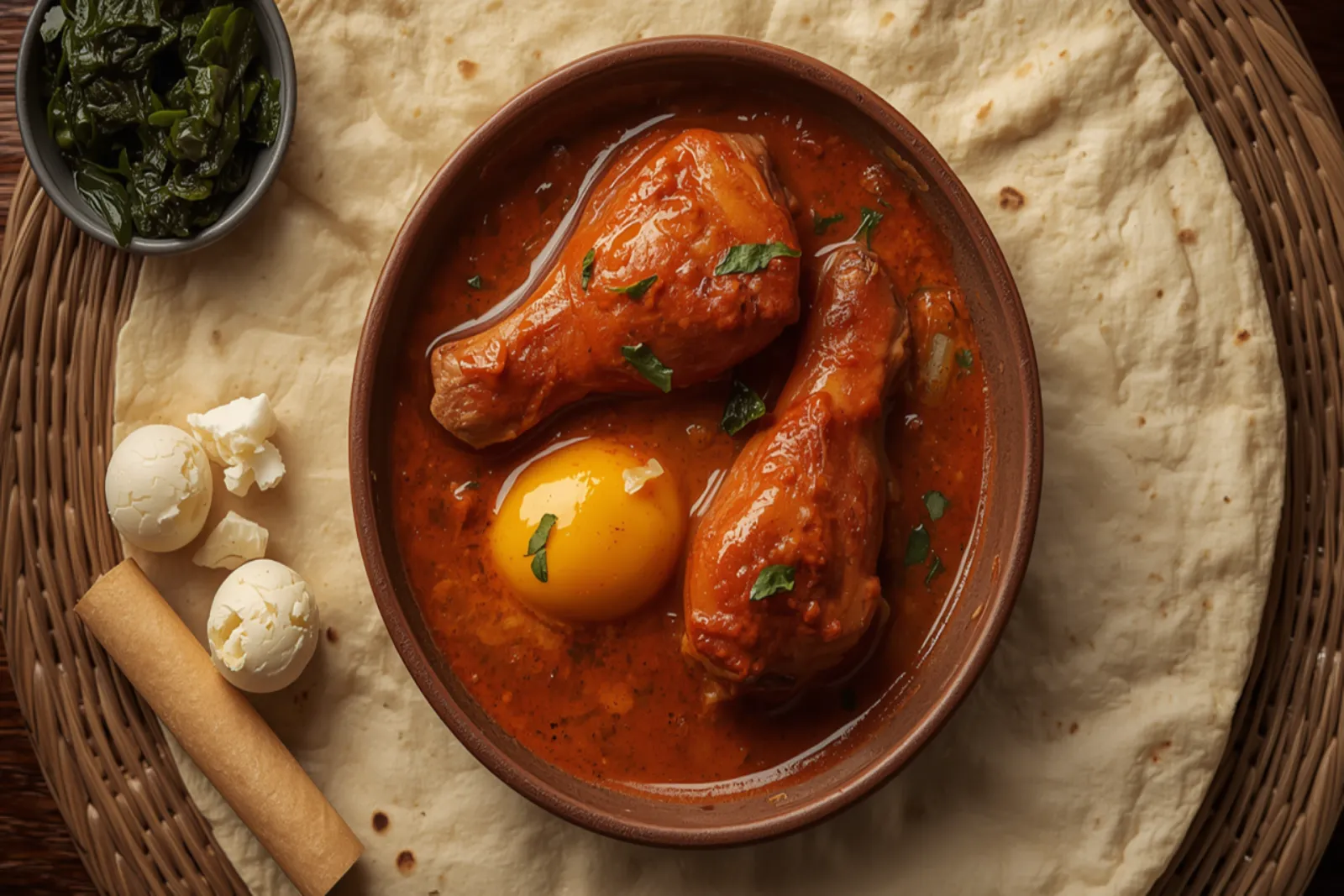
Ethiopia's feast-day chicken stew, built the slow way: a kilo of onions dry-cooked to a purée before any fat touches the pan, berbere and spiced butter bloomed into them, and chicken and whole eggs simmered until the sauce turns mahogany.
Published August 13, 2026
Cultural context
Doro wat is the dish Ethiopians cook when a fast ends. The Ethiopian Orthodox calendar sets aside more than 180 days a year without meat, dairy or eggs, so a stew built on chicken, butter and hard-boiled eggs is by definition celebration food — the centre of the table at Genna (Christmas), Fasika (Easter) and Meskel. Eritrean kitchens cook a close cousin under the name derho tsebhi, and the ancestry of both runs back through the Aksumite highlands. The chicken is traditionally jointed into twelve pieces, a count usually explained as the twelve apostles.
Doro wat is what an Ethiopian kitchen makes when a fast breaks. The Orthodox calendar sets aside more than a hundred and eighty days a year without meat, dairy or eggs, so a stew built on chicken, spiced butter and whole hard-boiled eggs is not merely dinner — it is the marker that a feast has begun. It appears at Genna and Fasika, at weddings and at the meal that welcomes a newborn, ladled into the middle of a communal round of injera and eaten with the hands. Eritrean cooks make a very close relative called derho tsebhi, and both descend from the same highland tradition, so this is a dish of the Horn of Africa rather than of a single modern border.
Onions are the sauce
Almost everything that makes doro wat unusual is decided in the first forty minutes, before the chicken is anywhere near the pot.
You start with a kilo of finely chopped red onions in a dry pan — no oil, no butter, no water. They sweat, then wilt, then collapse, and after half an hour of periodic stirring they have become a dense, brownish pulp that smells savoury rather than sweet. This is deliberate. Onions fried in fat from the beginning caramelise into golden shreds that stay recognisably onion; onions cooked dry break down entirely, and that broken-down pulp is the only thickener a wat has. There is no stock, no flour, no cream and no tomato in a traditional pot. Skip the dry stage and you will get chicken sitting in thin red liquid — perfectly edible, and not doro wat.
Niter kibbeh and berbere
The two jars that define Ethiopian cooking do very different jobs. Niter kibbeh is butter clarified over a long, low heat with fenugreek, korarima, nigella, cinnamon and highland herbs like koseret and besobela. Because the water and milk solids are removed it keeps for months at room temperature, and because spice aromatics dissolve into fat, it delivers those flavours in a way no amount of dry spice stirred into a stew ever could.
Berbere is the red half of the equation — chillies milled with fenugreek, korarima, ajwain, nigella, rue seed, ginger, cinnamon and cloves. It arrives raw, and the most common failure with this dish is treating it as a finished sauce. Give it five to eight full minutes frying into the buttery onions, over gentle heat, with a splash of water if it starts to catch. You will watch the colour shift from dusty brick to deep mahogany and the harshness cook out of the chillies. That transformation is the dish.
The eggs, and the long simmer
Hard-boiled eggs go in whole, and they are pricked or lightly scored first so the sauce can work into the white rather than sliding off it. After twenty-odd minutes they come out stained a burnished red and seasoned right through — the piece children reach for first.
From there it is patience. Two hours of gentle heat dissolves the last of the onion, draws gelatin out of the bones and reduces the sauce until a spoon leaves a track through it. Finish off the heat with a last spoonful of niter kibbeh and a pinch of ground korarima so the top notes are fresh, rest it for a quarter of an hour, and serve it in the middle of the injera with ayib alongside to take the edge off the heat.
If you’re building a wider African table, Lagos’s jollof rice and Morocco’s chicken tagine sit happily beside it — and there’s more on the dishes worth crossing a border for in the world classics guide.
Ingredients
For the niter kibbeh (spiced butter)
- 250 g unsalted butter Makes more than this stew needs. It keeps for months and improves everything you put it in, so there is no sense making a smaller batch.
- 1/2 small onion, roughly chopped
- 3 cloves garlic, lightly crushed
- 3 cm piece fresh ginger, sliced
- 1 tsp fenugreek seeds The signature note of Ethiopian butter — maple-sweet and faintly bitter. Use a level teaspoon; fenugreek turns acrid if you overdo it.
- 1 tsp nigella seeds (tikur azmud)
- 4 pods green cardamom, cracked Two pods of korarima — Ethiopian black cardamom — is the authentic choice if you can find it, smokier and more resinous than the green kind.
- 1 small cinnamon stick
- 1/2 tsp ground turmeric
- 1 tsp dried koseret, or dried oregano Koseret is a highland herb sold at Ethiopian grocers; oregano is the standard stand-in and gets you most of the way there.
For the chicken
- 1 whole chicken (about 1.5 kg) skinned and jointed into 12 pieces Or 1.2 kg of bone-in, skinless thighs and drumsticks. Bone-in matters: this is a two-hour braise and boneless breast will be dry long before the sauce is ready.
- 2 lemons, juiced, plus 1 tbsp salt For the traditional wash. Lime works equally well.
For the wat
- 1 kg (about 6 large) red onions, chopped as finely as you can manage Not a typo, and not negotiable. The onions are the sauce here — there is no stock, cream or flour doing that job. A food processor pulsed in short bursts is fine; puréed onions weep too much water.
- 8 cloves garlic, crushed to a paste
- 5 cm piece fresh ginger, grated
- 6–8 tbsp (60–80 g) berbere The heart of the dish: a chilli blend carrying fenugreek, korarima, ajwain, nigella, rue seed, ginger, cinnamon and cloves. Brands vary wildly in heat — start at six tablespoons and taste. Paprika-heavy supermarket berbere will need the full eight.
- 5 tbsp niter kibbeh, from above
- 2 tbsp neutral oil
- 120 ml (1/2 cup) tej, or dry red wine Tej is Ethiopian honey wine. Red wine is the accepted substitute; a dry white with 1 tsp honey stirred in is closer to tej's actual flavour.
- 500–700 ml hot water or light chicken stock
- 6 eggs, hard-boiled and peeled
- 1/2 tsp ground korarima or green cardamom Stirred in at the very end, off the heat, so its perfume survives.
- 2 tsp fine sea salt, plus more to taste
Method
Tap a step’s number to check it off as you go.
-
Make the niter kibbeh first. Melt the butter in a small pan over the lowest heat. When it foams, add the onion, garlic, ginger, fenugreek, nigella, cardamom, cinnamon, turmeric and koseret. Hold it at a bare tremble for 25–30 minutes, never letting it bubble properly, until the milk solids have sunk and browned and the butter above them is clear and deep gold. Strain through a fine sieve or muslin and set aside.
Why: Two things happen at once. The water cooks out and the milk solids drop, which is what makes the butter keep unrefrigerated and stops it burning at wat temperatures. And because spice aromatics are fat-soluble, they infuse into the butter far more completely than they ever would into a watery stew.
-
Put the chicken pieces in a bowl, cover with cold water, add the lemon juice and salt, and leave for 20–30 minutes. Rinse well and pat completely dry.
Why: The lemon-and-salt wash is a standard Ethiopian step. It firms the surface of the meat and takes off the faintly livery smell of raw chicken, which is worth doing when the meat will sit in the pot for two hours.
-
Put the chopped onions in a wide, heavy pot with no fat and no water at all. Set it over medium heat and cook, stirring every few minutes, for 25–35 minutes. They will sweat, collapse, and eventually start sticking and colouring at the base — scrape that up and keep going.
Why: This dry-cooking is the single most important technique in the dish and the one everyone skips. Fat added now would fry the onions into sweet golden shreds; cooked dry they instead break down into a thick, savoury pulp that becomes the body of the sauce. Ethiopian wat is thickened by onion, nothing else.
-
Only when the onions have collapsed to a dense, jammy mass, add the oil and 3 tablespoons of the niter kibbeh. Cook for another 10 minutes until the onions are glossy and a shade darker.
Why: Now the fat has something to work with. Adding it late means the onions absorb butter rather than being fried in it, which is why the finished sauce is rich without tasting greasy.
-
Stir in the garlic and ginger and cook for 2 minutes, then add the berbere and fry it into the onions for a full 5–8 minutes over low heat, stirring constantly and adding a splash of water if it threatens to catch.
Why: Berbere is a raw spice blend, not a finished sauce. Frying it in fat cooks off the dusty, harsh edge of the chillies and dissolves their colour into the oil — this is where the stew turns from brick to mahogany. Rush it and the whole pot tastes of raw chilli powder.
-
Pour in the tej or wine and let it bubble away for 2 minutes, scraping the base.
Why: Alcohol dissolves aromatic compounds that neither water nor fat will, and honey wine adds exactly the trace of sweetness that keeps a berbere sauce from reading as flat heat.
-
Add 400 ml of the hot water and 1 1/2 teaspoons of salt. Simmer, uncovered, for 20 minutes, until the sauce thickens and beads of red oil rise to the surface.
Why: The oil separating out is the doneness signal for the base, the same one Indian and West African cooks use. It means the water has gone and the sauce is frying rather than boiling — the point at which the chicken can go in without diluting anything.
-
Slide in the chicken pieces, turning them so each is coated. Add just enough hot water to half-submerge them, cover, and simmer gently for 45 minutes, turning the pieces two or three times.
Why: Half-submerged, not swimming. Chicken releases a surprising amount of its own liquid, and a wat is meant to be thick enough to scoop with bread, never soupy.
-
Prick each hard-boiled egg all over with a fork, or score it lightly in a few places, and nestle the eggs into the sauce. Cover and cook for a further 20–25 minutes.
Why: Scoring lets the sauce work into the white instead of sliding off it, so the eggs come out stained deep red and seasoned through — the point of putting them there in the first place.
-
Uncover and simmer for a final 15–20 minutes until the sauce is thick enough to hold the mark of a spoon and the chicken is falling from the bone. Taste and correct the salt.
Why: Two hours in, the onions have completely disintegrated and the collagen in the chicken has turned to gelatin. That combination — not any thickener — is what gives a good wat its clinging, velvety texture.
-
Off the heat, stir in the remaining 2 tablespoons of niter kibbeh and the ground korarima. Rest, covered, for 15 minutes before serving.
Why: Butter and cardamom added at the end stay volatile and fragrant; stirred in an hour earlier they would have cooked away into the general background.
A quick, anonymous tap — no review needed.
Variations
- Alicha doro (mild)
The non-spicy sibling, cooked for children, elders and anyone with an unhappy stomach. Leave out the berbere entirely and build the same onion base with 2 teaspoons of turmeric, a little more ginger and green chilli instead — you get a golden, gentle stew rather than a red one.
- Sega wat / key wat (beef)
Swap the chicken for 1.2 kg of cubed beef chuck and give it 2 to 2 1/2 hours in the sauce. Everything else is identical; this is the version that turns up when a household has slaughtered an ox for a holiday.
- Vegan
Ethiopian fasting cooking is one of the world's great vegan traditions. Use the same onion-and-berbere base with oil instead of niter kibbeh, then finish with red lentils (misir wat) or cubed potato, carrot and cabbage. Infuse the oil with the same spices to mimic the butter.
- Slow cooker
Do the dry onions, the berbere fry and the reduction on the hob — none of that works in a slow cooker — then transfer with the chicken and cook on low for 4 hours, adding the eggs for the last 45 minutes.
- Shortcut butter
No time for niter kibbeh? Melt 100 g of butter with 1/2 teaspoon each of fenugreek, cardamom and turmeric for 10 minutes and strain. It is a fair approximation, though the real thing is what makes the dish taste like a restaurant's.
Serving & Storage
Spoon it into the centre of a large round of injera laid over a communal platter, with more injera rolled up alongside for scooping. A mound of ayib — the mild, crumbly Ethiopian fresh cheese — goes on the side, and its whole job is to cool the berbere between mouthfuls. No cutlery: you tear, pinch and scoop with your right hand.
Pairs with: Injera, Ayib (fresh cheese), Gomen (stewed collard greens), Atakilt wat (cabbage, carrot and potato), Tej (honey wine), Ethiopian buna (coffee).
Storage: Refrigerates for 4 days and is genuinely better on day two, once the berbere has settled. Cool within two hours; store the eggs in the sauce so they keep taking on colour. Reheat gently with a splash of water — hard boiling will toughen the eggs. The stew freezes well for 3 months, though it is worth freezing it without the eggs and boiling fresh ones on the day, as freezing turns egg white rubbery.
Nutrition
Per serving (1 chicken piece, 1 egg and sauce (about 1 1/4 cups))
- Calories
- 520
- Protein
- 38 g
- Carbs
- 22 g
- Fat
- 31 g
- Fiber
- 4 g
- Sugar
- 9 g
- Sodium
- 790 mg
Notable micronutrients: Iron, Vitamin A, Vitamin B12, Selenium, Potassium
Estimated using standard ingredient data. Values vary with brands and substitutions.
Frequently Asked Questions
Do I really need a kilo of onions?
Yes. Doro wat contains no stock, cream, flour or tomato to build a sauce with — the onions are the sauce. Cooked dry and then slowly in butter, a kilo of them collapses into roughly a litre of thick, savoury pulp that carries the berbere and clings to the chicken. Halve the onions and you get spiced chicken in red liquid, which is a different and much worse dish.
What exactly is berbere, and can I substitute it?
Berbere is Ethiopia's foundational chilli blend: dried chillies plus fenugreek, korarima (Ethiopian cardamom), ajwain, nigella, rue seed, ginger, garlic, cinnamon, cloves and allspice, sun-dried and milled. There is no true substitute, because the aromatics are as important as the heat, and a mix of paprika and cayenne gets you colour and burn but none of the perfume. It is sold in every Ethiopian and Eritrean grocer and widely online. Note that mitmita is not the same thing — it is hotter, simpler and used as a table condiment.
Why is the chicken skinned, and why twelve pieces?
Skin is removed because the sauce is already carrying a great deal of butter; leaving it on makes the wat slippery and the skin itself never crisps under a two-hour braise. The twelve-piece cut — two drumsticks, two thighs, two wings, the breast quartered, and the back — is traditional, and is usually explained as one piece for each apostle, in a dish tied to the Orthodox feast calendar.
Is doro wat very spicy?
It is properly hot, but the heat is broad and warming rather than sharp, because berbere carries as much fenugreek, cardamom and cinnamon as it does chilli. Start with six tablespoons, taste after the berbere has fried, and remember that ayib, injera and a long rest all soften it. If you want the flavour without the fire, cook alicha doro from the variations instead.
Can I make it ahead for a party?
It is arguably better made ahead — this is a dish Ethiopian families start the day before a holiday. Cook it fully, cool it quickly and refrigerate; the sauce thickens and the berbere mellows overnight. Reheat gently over low heat with a splash of water, and add the ground korarima and a spoonful of fresh niter kibbeh just before serving to bring the aroma back.
What do I serve it with if I can't get injera?
Injera's sourness is a real part of the balance, so the nearest substitutes are other sour flatbreads — a soft sourdough flatbread or a thin, tangy pancake works. Failing that, plain steamed rice is the common household compromise outside Ethiopia. Whatever you use, keep something cooling on the plate: yoghurt, fresh cheese or a plain green salad.
What to drink with this
All drinks →Hand-picked pours to match this dish.

North & West India (peak-summer drink across the subcontinent) · Indian
Aam Panna (Raw Green Mango Summer Cooler)
India's tangy, jade-green raw-mango cooler — roasted or boiled green mangoes blended with cumin, black salt and mint. The traditional heat-stroke remedy that tastes like summer.

Mexico (agua fresca tradition) · Mexican
Agua de Jamaica (Hibiscus Iced Tea)
Mexico's ruby-red hibiscus cooler: dried jamaica flowers steeped, sweetened and chilled into a tart, refreshing agua fresca. The right steep, how to control the tartness, and why it's so good for you.
Pan-Indian (North & West India) · Indian
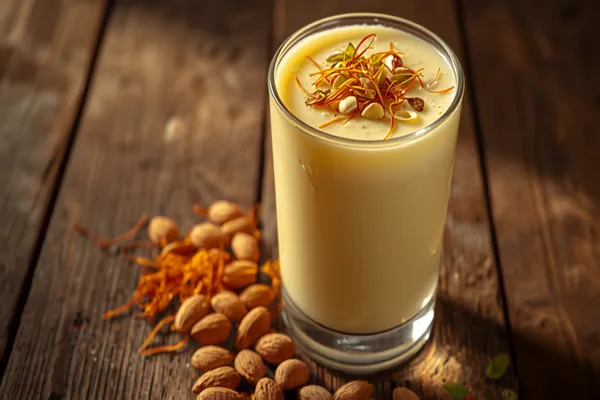
Badam Milk (Saffron Almond Milk)
Milk simmered with a paste of soaked almonds, saffron, cardamom and a whisper of nutmeg — India's rich, fragrant almond drink. Comforting served warm in winter, reviving served chilled in summer, festive any time.
From our kitchen community
Ratings & Reviews
My Rating
Tap a star to rate — no sign-in, no form needed.
My Review
0 Ratings
🥣 0 home cooks made it!
Be the first to rate Doro Wat (Ethiopian Spiced Chicken Stew).
Related Recipes

Lagos and south-western Nigeria — part of the wider West African jollof belt · Nigerian
Jollof Rice (Nigerian Party Style)
West Africa's great one-pot rice, cooked the Lagos party way: a long-fried pepper-and-tomato base, parboiled long-grain rice steamed until every grain is stained red, and a deliberately toasted bottom pot for that smoky finish.
Morocco · Moroccan
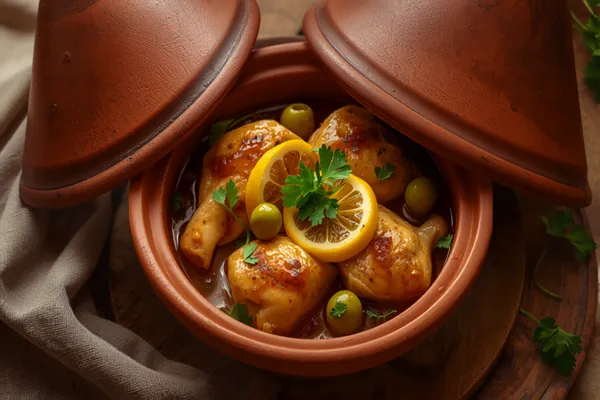
Moroccan Chicken Tagine with Preserved Lemon and Olives
The classic of the Moroccan table: chicken slow-cooked with preserved lemon, green olives, ginger, and saffron until the meat slips off the bone in a golden, deeply savoury sauce. Aromatic, gently spiced, and far easier than it looks.
Morocco (Maghreb) · Moroccan
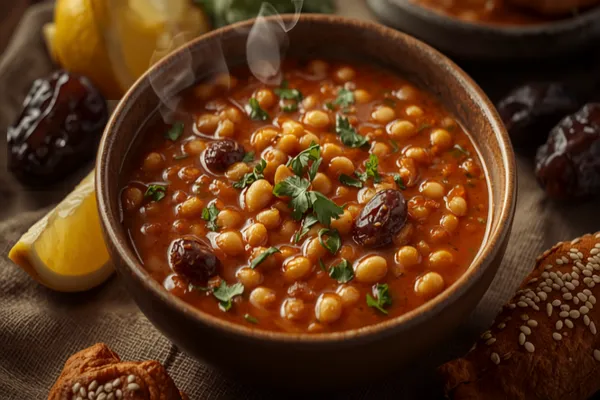
Harira (Moroccan Chickpea, Lentil and Tomato Soup)
Morocco's beloved soup: a hearty, tangy broth of chickpeas, lentils and tomatoes thickened with a flour-and-water tadouira, fragrant with ginger, turmeric and a flurry of herbs. The traditional dish for breaking the Ramadan fast.
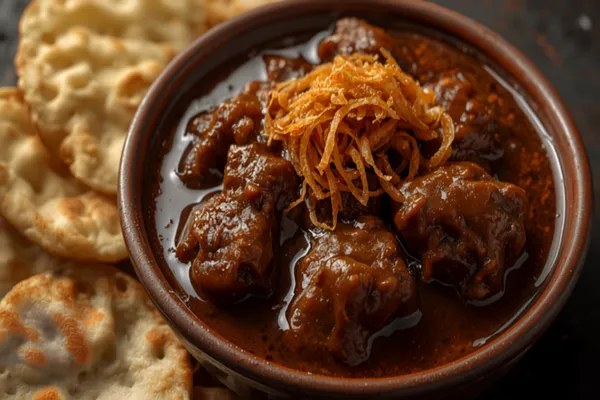
West Bengal / East India · Indian
Kosha Mangsho (Bengali Slow-Cooked Mutton Curry)
Bengal's Sunday-best mutton: goat marinated in yogurt and mustard oil, then slow-cooked with onions and whole spices until the gravy turns dark, thick, and clinging. 'Kosha' means slow-fried — and the patience is the dish.
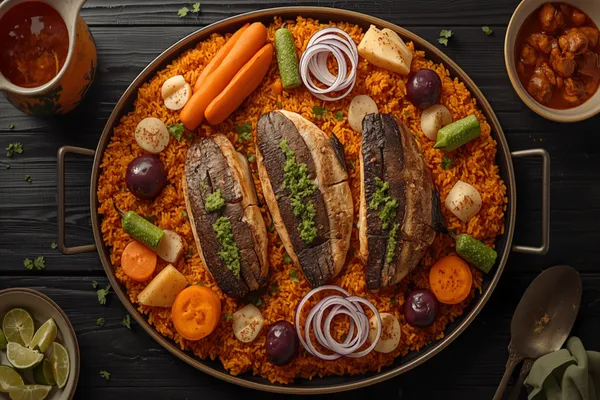
Saint-Louis and the Atlantic coast of Senegal — now cooked nationwide, from Dakar to the Casamance · Senegalese
Thieboudienne (Ceebu Jën) — Senegalese Fish and Broken Rice
Senegal's national dish and UNESCO-listed culinary art: whole fish stuffed with a pounded parsley-and-garlic rof, fried, then simmered with cassava, cabbage and carrot in a long-fried tomato base — and broken rice steamed in that broth until every grain drinks it up.
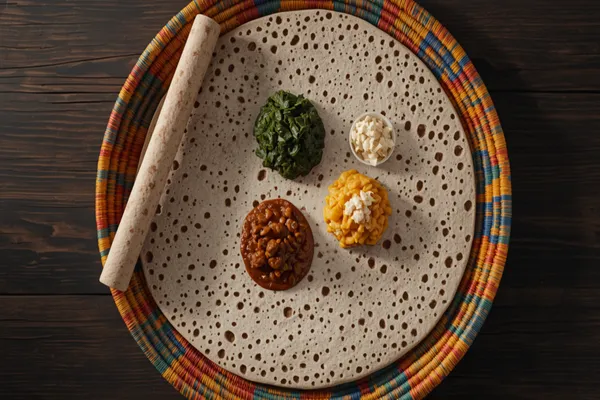
The Ethiopian and Eritrean highlands — teff country, from Gojjam and Shewa north into the Eritrean plateau · Ethiopian
Injera (Ethiopian and Eritrean Teff Flatbread)
The sour, lace-holed teff flatbread that is plate, cutlery and staple across the Horn of Africa — fermented for three days, thickened with a cooked absit, and cooked on one side only until the eyes open.
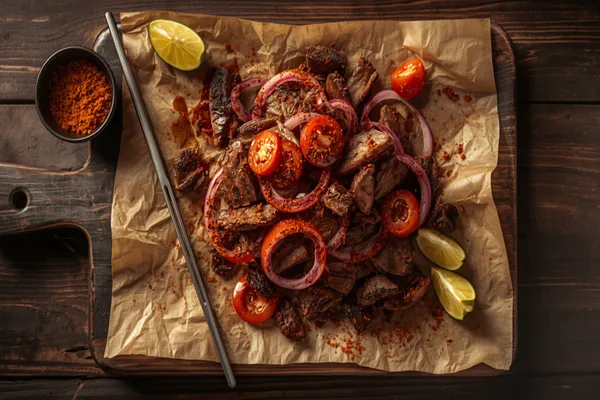
Hausaland — northern Nigeria (Kano, Zaria, Sokoto) and across the Sahel into Niger, Chad and northern Cameroon · Nigerian
Suya (Tsire) — Hausa Grilled Beef Skewers with Yaji
Nigeria's great night-time street food: beef sliced paper-thin, oiled, buried twice in a dry peanut-and-chilli rub, and grilled fast over charcoal. The secret is that yaji is a dry rub, not a marinade — and that the peanut in it has had its oil pressed out.

Cape Town and the Western Cape — the Cape Malay kitchens of the Bo-Kaap and the wider Cape · South African
Bobotie — Cape Malay Curried Mince with a Golden Egg Custard
South Africa's great baked dish: mildly curried mince sweetened with dried fruit, bound with milk-soaked bread, and finished under a thin turmeric-yellow custard with bay leaves standing in it. The two things that decide the outcome are the soaked bread and a loosely levelled top.

Northern Ghana — Dagbon and the Hausa zongo quarters, now sold at every roadside in Accra and Kumasi · Ghanaian
Waakye (Ghanaian Rice and Beans with Sorghum Leaves)
Ghana's great breakfast: long-grain rice and black-eyed peas simmered with dried red sorghum leaf sheaths until every grain turns burgundy, then loaded with shito, gari, talia and a boiled egg the way the roadside sellers of Accra do it.
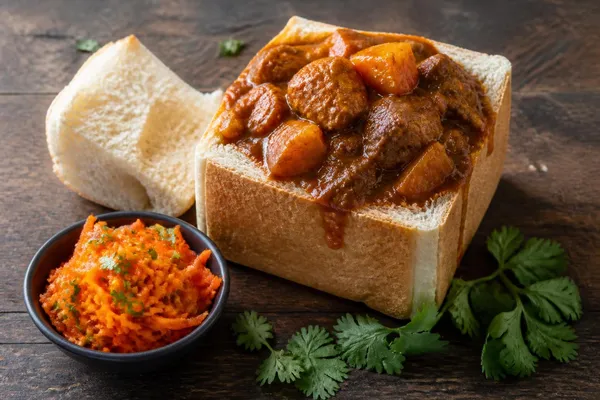
Durban, KwaZulu-Natal, South Africa · South African (Durban Indian)
Bunny Chow (Durban Lamb Curry in a Bread Loaf)
A quarter-loaf of hollowed white bread brimming with fiery Durban lamb curry — South Africa's most iconic street food, born from the Indian community of KwaZulu-Natal. No cutlery required; the bread is the bowl.