Iran — the Caspian rice provinces of Gilan and Mazandaran, refined in the court kitchens of Isfahan and Tehran · Persian
Tahdig (Persian Crispy Rice Crust)
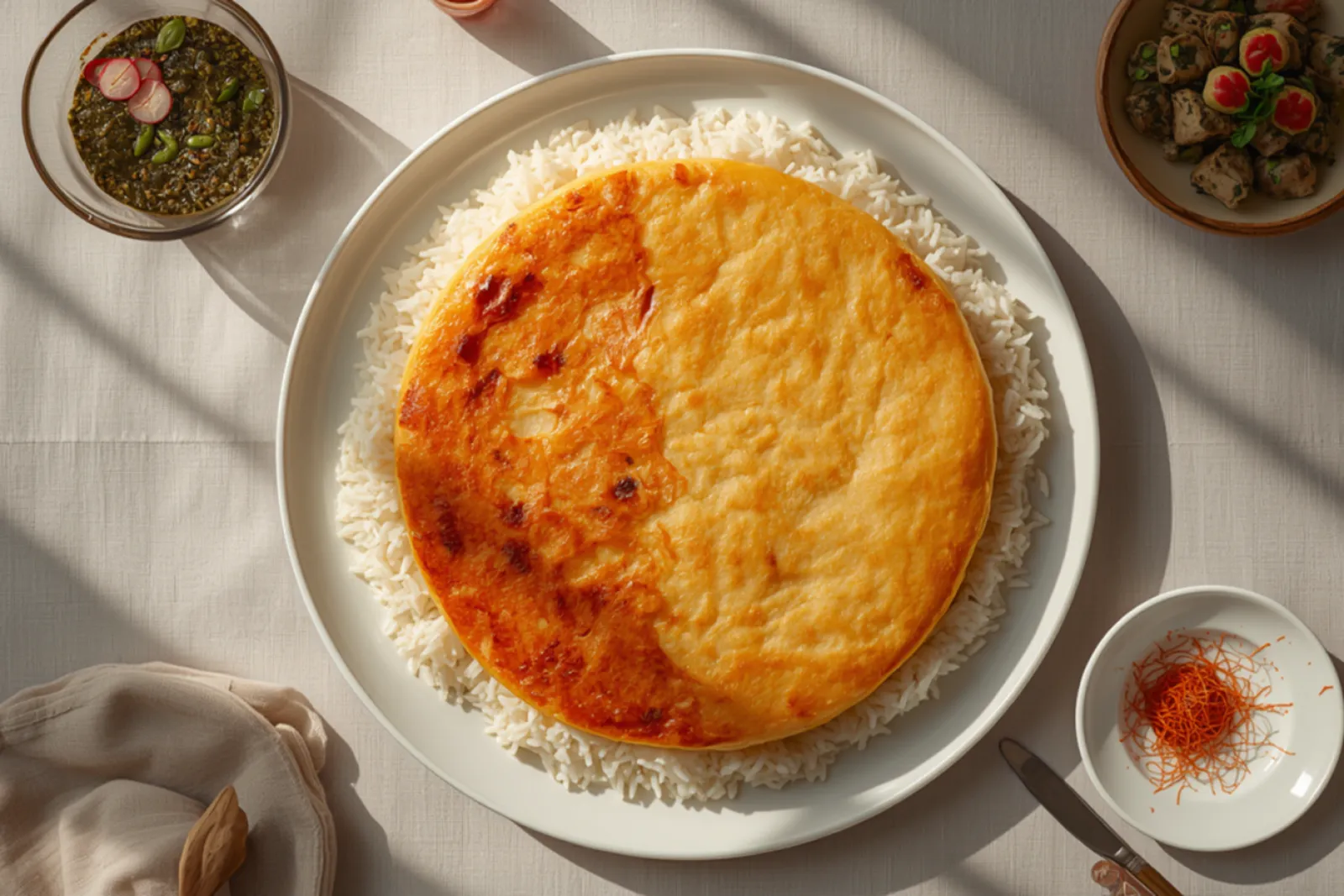
The golden, shattering crust at the bottom of a Persian rice pot — saffron, yogurt and long-grain rice fried slowly into a single lacquered disc, inverted onto the platter and fought over before anyone touches the stew.
Published September 16, 2026
Cultural context
Tahdig means, exactly and unromantically, 'bottom of the pot' — tah, bottom; dig, pot. It is not a separate dish but the crust that forms under any properly steamed Persian rice, and it is the reason the pot gets inverted onto the platter rather than spooned out. Persian cooks have been steaming rice this way since at least the Safavid era, when the chelow (plain steamed rice) and polow (rice cooked with meat, fruit or herbs) methods were codified in court kitchens; crisp rice crusts appear on Qajar royal menus by the nineteenth century. A crust that lifts out whole is the household measure of whether someone can cook, and it is customarily offered to guests first. The same crust belongs to the whole Persianate world under other names — qazmaq in Azerbaijan, hkaka among Iraqi Jews, and versions of it in Afghan and Kurdish kitchens — so it is a regional inheritance rather than any one country's invention.
Tahdig is the part of the meal Iranians reach for first and the part a cook is judged on. The name is flatly descriptive — tah, bottom; dig, pot — and that is all it is: the layer of rice that sits against hot metal for the better part of an hour and turns into a single golden, shattering disc. It is not a recipe so much as an outcome, the reward for cooking rice the long Persian way, and it is why a pot of chelow gets inverted onto a platter with a certain amount of ceremony rather than spooned out like any other rice.
The method behind it is old. Persian cooking distinguishes between chelow, plain rice parboiled then steamed; polow, the same rice steamed with meat, fruit or herbs folded through it; and kateh, the simpler absorption-cooked rice of the Caspian north, which is deliberately sticky and has no crust at all. Chelow and polow were codified in the court kitchens of the Safavid era, and by the nineteenth century a crisp rice crust was appearing on Qajar royal menus. The crust is not uniquely Iranian, either — Azerbaijani cooks call it qazmaq, Iraqi Jewish families hkaka, and Afghan and Kurdish kitchens make their own versions. It belongs to a whole Persianate region rather than to one border.
Everything happens before the pot goes on
The rice has to be aged, and it has to be washed
The grain matters more here than in almost any other rice dish. Iranian varieties — sadri, or the prestigious domsiah, named for the black speck on one end — are extra-long, aromatic and, critically, aged for a year or more before sale. Aged rice has given up moisture, so it absorbs water evenly and stretches to nearly twice its length during cooking instead of splitting. Aged basmati behaves the same way and is a real substitute. New-crop rice is not: it will clump no matter how carefully you work.
Then rinse it. Five or six changes of water, swirling with your hand, until the cloudiness is gone. The cloudiness is loose surface starch, and it is the only thing standing between separate grains and a sticky mass.
Salt is structural, not seasoning
Four tablespoons of salt in the soaking water looks like a typo. It is not, and almost none of it stays in the food — it drains away with the soaking water and again after the parboil. Salt at that concentration firms the outer layers of the grain so it can survive a hard rolling boil without fraying, which is exactly what allows Persian rice to elongate rather than break. Skip it and the boil chews the grains up.
The parboil is the moment it can go wrong
The rice goes into a large volume of hard-boiling salted water for five to seven minutes and no longer. You are looking for a very specific state: the grain soft at the ends, with a distinct opaque core still in the middle, bending rather than snapping when you press it. It will be genuinely underdone, and it should be — there are another fifty minutes of steam to come.
Ninety seconds past that point is unrecoverable. The rice finishes cooking in boiling water, then spends the steaming phase going slack, and you get a soft, clumped result with a pale, floppy crust. Start testing at five minutes and keep testing.
Building the crust
The bottom layer is the whole trick. Mix a couple of ladles of the parboiled rice with yogurt, saffron liquid, oil and — if you want a crust you can invert without holding your breath — an egg yolk. Yogurt and yolk bring milk proteins, lactose and fat to a layer that would otherwise be pure starch, and proteins and sugars brown through the Maillard reaction at temperatures plain starch barely colours at. That is why a yogurt tahdig comes out an even deep gold, and why it holds together as one sheet instead of breaking into gravel.
Press that layer flat into hot oil, with a splash of water in the pan. The water lowers the fat temperature just enough to give the crust a few minutes of gentle steaming before frying properly begins, so it cooks through rather than searing dark in the middle and staying blond at the rim.
Then leave it alone for an hour
Heap the rest of the rice loosely on top in a pyramid, well away from the pot walls, and poke five or six chimneys down through it with a spoon handle. Eight to ten minutes on medium-high to set the crust — you should hear a steady sizzle and smell toast — then the lid, wrapped in a tea towel, and the lowest heat you have for forty-five to fifty minutes.
The towel is not optional. It is called the damkoni, and its job is to absorb the condensation that would otherwise collect on the lid and rain back down onto the rice, softening the top and slackening the crust. This long gentle phase is dam kardan, the steaming, and it is where the grains separate, dry slightly and become fluffy.
The flip
Sit the base of the pot in a couple of centimetres of cold water for three to five minutes. The thermal shock contracts the crust away from the metal and does most of the work of releasing it. Then spoon the loose rice off onto a warm platter first, so that you are only inverting a crust and a thin layer of rice rather than the entire pot, lay the platter over it and turn it in one movement.
If it comes out whole you have made something people will talk about for the rest of the meal. If it comes out in pieces, lay the pieces over the rice and serve it anyway — that is what most Iranian households eat most nights, and by custom the guests still get first refusal.
Serve it as it is meant to be served: as the bed for a stew. Start with ghormeh sabzi, the herb-and-dried-lime khoresh that Iranians name when asked what Iran tastes like, and read the world classics guide for where the rest of this table sits.
Ingredients
For the rice
- 500 g (about 2 1/2 cups) aged extra-long-grain rice — Iranian sadri or domsiah if you can find it, otherwise aged basmati Aged rice is not a luxury here, it is the mechanism. A grain that has been stored a year or more has lost moisture, absorbs water more evenly and elongates instead of splitting during the hard boil. New-crop or short-grain rice turns sticky and will never give you separate grains. Iranian domsiah — 'black end', named for the dark speck on one tip — is the prestige variety; good aged basmati is a genuine substitute.
- 4 tbsp plus 2 tbsp fine sea salt Four tablespoons go into the soaking water and two into the parboiling water. This sounds alarming and is not — almost all of it is drained away. The salt is doing structural work, not seasoning.
- 3 litres water, for parboiling
For the saffron
- 1/2 tsp (about 0.3 g) saffron threads, ground to a powder with a pinch of sugar Grind it in a mortar with a few grains of sugar, which give the pestle something to work against. Use Iranian or Spanish threads, deep red with no yellow styles mixed in; powdered saffron sold loose is very often adulterated.
- 4 tbsp hot (not boiling) water or 3 ice cubes Iranian cooks often bloom saffron on ice — as the cube melts it extracts slowly and cold, which pulls more colour and less of the bitter edge that boiling water can drag out.
For the tahdig
- 4 tbsp neutral oil — sunflower, grapeseed or light olive Oil, not butter, for the layer that meets the metal. Butter's milk solids scorch and turn bitter long before a crust has formed over forty-five minutes.
- 2 tbsp unsalted butter or ghee, melted Added over the rice, where it is insulated from direct heat, purely for flavour and richness.
- 3 tbsp full-fat plain yogurt, preferably strained Greek-style The classic ta'dig-e mast. Milk proteins and lactose brown far faster and more evenly than starch alone, which is why a yogurt crust comes out a deep even gold and holds together as one disc. Low-fat yogurt is watery and will steam rather than fry.
- 1 egg yolk (optional) Traditional in many households and worth it — it sets the bottom layer into something closer to a thin crisp omelette, which makes the crust structurally sturdy enough to invert in one piece.
To finish
- 2 tbsp water
- 1 tbsp rose water or a splash more melted butter (optional) A traditional flourish sprinkled over the mounded rice before steaming; use it sparingly or it dominates.
Method
Tap a step’s number to check it off as you go.
-
Rinse the rice in a bowl of cool water, swirling with your hand and pouring off the cloudy water, five or six times, until the water runs almost clear. Then cover with cool water by 5 cm, stir in 4 tbsp of the salt, and leave to soak for 1–2 hours (overnight is fine if it is cool).
Why: Rinsing strips the loose surface starch that would otherwise glue the grains together — this is the single difference between fluffy Persian rice and a sticky clump. The soak pre-hydrates the grain so the boil that follows can be short, and the salt is doing something less obvious: it firms the outer layers of the grain so they survive a hard rolling boil without fraying, and it is what lets Persian rice elongate to almost twice its raw length rather than break.
-
Bring 3 litres of water to a hard rolling boil in a wide pot with the remaining 2 tbsp salt. Drain the rice and tip it in. Boil, uncovered and untouched apart from one gentle stir to stop it settling, for 5–7 minutes.
Why: This is a parboil, not a cook — the rice will spend the next 50 minutes steaming and will finish there. It needs to go into the pot at what Iranian cooks call 'soft outside, firm inside'.
-
Start testing at 5 minutes. Lift out a grain, bite it or squeeze it between finger and thumb: it should give at the ends and still have a distinct opaque, slightly chalky core, and it should bend rather than snap. The moment it does, drain it into a colander and rinse briefly with lukewarm water.
Why: Overshoot this by ninety seconds and nothing later can save it — the grains will be fully cooked before the steam has done its work, and you will get a soft, clumped rice with a pale crust. The lukewarm rinse arrests the cooking and washes off the excess surface salt. Use lukewarm, not cold: a cold shock makes the outer starch seize and the grains stiffen.
-
Bloom the saffron: put the ground saffron in a small bowl with the hot water or ice cubes and leave it for 10 minutes until the liquid is a deep orange-red.
Why: Ground saffron in liquid releases crocin (colour) and picrocrocin (flavour) far more completely than whole threads dropped into a pot, where most of the pigment stays locked in the thread. A slow, cool extraction gives the strongest colour with the least bitterness.
-
In a bowl, mix 3 large ladles (about 2 cups) of the drained rice with the yogurt, the egg yolk if using, 2 tbsp of the bloomed saffron liquid and 1 tbsp of the oil. Stir gently until every grain is coated and pale gold.
Why: This seasoned, fat-coated, protein-bound layer is what becomes the crust. Yogurt and yolk brown through the Maillard reaction at temperatures plain starch barely reddens at, and they bind the grains into a sheet so the finished crust lifts out whole rather than in gravel.
-
Set a heavy non-stick or well-seasoned pot (26 cm is ideal) over medium heat. Add the remaining 3 tbsp oil and 2 tbsp water and let it get hot but not smoking. Spread the yogurt rice over the base in an even layer, pressing it down flat with the back of a spoon.
Why: The splash of water is an old trick and a good one — it drops the starting temperature of the fat and buys the layer a few minutes of gentle steaming before frying begins, so the crust cooks through evenly instead of searing dark in the centre and staying pale at the edges. Press this layer, and only this layer: it needs contact with the metal.
-
Mound the remaining rice on top in a pyramid, spooning it in loosely from the centre outwards. Do not pack it. With the handle of a wooden spoon, poke 5 or 6 holes right down through the rice to the crust layer. Drizzle over the melted butter, the rest of the saffron liquid over one section, and the rose water if using.
Why: The pyramid and the holes are a steam-management system. Heaping the rice away from the pot walls keeps the outer grains from stewing in condensation, and the chimneys let steam rise evenly through the whole mound instead of pooling at the bottom and waterlogging the crust. Saffron liquid goes over one part only so you end up with both white and gold rice to mingle on the platter — an Iranian table expects the contrast.
-
Cook uncovered over medium-high heat for 8–10 minutes, until you can hear a steady sizzle and smell toasting rice. Then wrap the lid in a clean tea towel, knotting the corners over the handle, clamp it on, and turn the heat to its lowest setting. Steam for 45–50 minutes.
Why: The first burst of heat sets the crust; the long low phase is dam kardan, the steaming, and the towel is the damkoni. Without it, condensation collects on the underside of the lid and rains back onto the rice, which is how you get a soggy top and a slack crust. The towel absorbs every drop. A flame diffuser is worth using on a gas hob — the crust burns from an unevenly hot spot far more often than from too long a cook.
-
Uncover. The rice should be fluffy and completely separate. Sit the base of the pot in 2–3 cm of cold water in the sink for 3–5 minutes.
Why: The thermal shock contracts the crust away from the metal and releases it. This is the step that turns an anxious flip into a reliable one, and it costs nothing.
-
Spoon most of the loose rice onto a warm platter, mounding it. Run a thin spatula around the edge of the crust, lay the platter face-down over the pot, and invert the whole thing in one confident movement. Lift the pot away.
Why: Taking the loose rice off first means you are only flipping a crust and a thin layer, not two kilos of hot rice — far less can go wrong. If a piece does stick, lever it out and lay it on top; nobody at an Iranian table has ever objected to a tahdig served in shards.
A quick, anonymous tap — no review needed.
Variations
- Potato tahdig (ta'dig-e sib zamini)
The most forgiving version and the usual one in Iranian restaurants abroad. Slice a large waxy potato into 5 mm rounds, pat them completely dry, toss in saffron liquid and a little salt, and lay them in a single overlapping layer in the hot oil before the rice goes on. They shield the rice from direct heat, so the margin for error is far wider — and the discs come out like saffron crisps.
- Lavash or tortilla tahdig
Line the oiled pot with sheets of lavash, letting them climb the sides, then build the rice on top. It produces a continuous crisp golden shell that comes out in one dramatic piece and is the easiest of all to unmould. Not gluten-free, obviously, and a flour tortilla does the job just as well.
- Plain rice tahdig (ta'dig-e berenj)
No yogurt, no yolk — just parboiled rice pressed into hot oil with saffron. This is the everyday Iranian crust: thinner, lacier, more brittle, and more likely to come out in fragments. Purists prefer it because you taste only rice and saffron.
- Vegan
Use a thick unsweetened coconut or soy yogurt in place of dairy, skip the yolk, and replace the butter with more oil. The browning is a little slower and the crust slightly less cohesive — the potato variation is the more reliable vegan route.
- Tahchin
The luxurious relative, and a different dish rather than a crust: the whole pot is built from rice bound with yogurt, egg and saffron, usually layered with chicken or lamb and barberries, then baked or steamed until the entire cake is crisp on every surface. Tahdig is the bottom of the pot; tahchin is a pot that is all bottom.
Serving & Storage
Tahdig is never eaten alone. It goes to the table as part of chelow — the platter of steamed rice it came from, heaped with the golden saffron rice spooned over the white — beside a khoresh (stew) for people to spoon over. The classic partners are ghormeh sabzi or a walnut-and-pomegranate fesenjan, with a dish of torshi (sour pickles), fresh sabzi khordan (a plate of raw herbs, radishes and feta) and a glass of doogh, salted mint yogurt drink. Break the crust into rough shards at the table rather than cutting neat wedges, and pass it first — by long custom it belongs to the guests.
Pairs with: Ghormeh sabzi, Grilled kebab koobideh, Mast-o-khiar (yogurt and cucumber), Torshi pickles, Doogh or strong black tea.
Storage: Eat the crust the day it is made — it softens within hours and never fully crisps again. Leftover loose rice keeps 3 days refrigerated and reheats beautifully with a splash of water in a covered pan over low heat, or in a microwave under a damp cloth. Leftover tahdig itself is best repurposed rather than reheated: break it up and crisp the pieces in a dry frying pan, or do what many Iranian households do and eat it cold, standing at the fridge. Cooked rice should be cooled quickly and refrigerated within an hour — it is one of the few foods where slow cooling carries a real risk of Bacillus cereus.
Nutrition
Per serving (1 serving (about 165 g rice plus a piece of crust))
- Calories
- 395
- Protein
- 7 g
- Carbs
- 66 g
- Fat
- 11 g
- Fiber
- 1 g
- Sugar
- 1 g
- Sodium
- 420 mg
Notable micronutrients: Manganese, Selenium, Folate, Thiamine, Calcium
Estimated using standard ingredient data. Values vary with brands and substitutions.
Frequently Asked Questions
Why did my tahdig stick to the pot?
Nearly always one of three things. Not enough fat — the base layer needs to be sitting in oil, not brushed with it. Too little heat at the start, so the crust never actually fried and set before the long steam began. Or skipping the cold-water bath at the end, which is what contracts the crust away from the metal. A heavy non-stick pot removes most of the risk; if you are using stainless steel, add another tablespoon of oil and be generous with the initial 8–10 minutes on medium-high.
Can I make tahdig without an Iranian rice pot or a non-stick pan?
Yes. Any heavy-based pot with a tight lid works — a Dutch oven, a deep sauté pan, a wide saucepan. What matters is that the base is thick enough to spread heat evenly, because a thin pot creates a hot spot that burns one part of the crust black while the rest stays blond. If your pot is thin, use a flame diffuser or an upturned cast-iron pan under it. The lid must be wrapped in a towel whatever the pot.
My rice came out sticky and clumped rather than fluffy. What went wrong?
Either the rice was not rinsed until the water ran clear, or it was parboiled too long, or it was the wrong rice. Surface starch is the glue, and only repeated rinsing removes it. The parboil should stop while the centre of the grain is still firm and chalky — if it is fully tender in the pot of boiling water, it is already overcooked, because it has 45 more minutes of steaming to come. And new-crop or medium-grain rice simply cannot produce this texture, however carefully you treat it; you need aged long-grain.
How much saffron do I actually need, and can I substitute turmeric?
Half a teaspoon of threads, ground, is plenty for 500 g of rice — saffron is powerful and more of it turns medicinal rather than better. Turmeric will give you a yellow colour and a completely different, earthy flavour; it is a colour substitute, not a saffron substitute, and Iranian cooks would not recognise the result. If saffron is out of reach, the more honest choice is to make the crust plain and let the rice and toasted crust carry it.
Is tahdig the same as tahchin?
No, though they are close relatives and use the same yogurt-saffron-egg idea. Tahdig is the crust that forms at the bottom of an ordinary pot of Persian rice — everything above it is loose, fluffy chelow. Tahchin is a dish in its own right: the entire pot is bound with yogurt, egg and saffron, usually layered with chicken and barberries, and cooked until it turns out as a solid golden cake, crisp all over. Tahdig is a layer; tahchin is the whole thing.
Do I have to soak the rice for two hours?
You get a noticeably better result if you do, but an hour is workable and even thirty minutes in warm salted water helps. What you cannot skip is the salt in the soaking water, which firms the grain, and the rinsing beforehand. If you are short of time, soak in lukewarm rather than cold water — hydration happens roughly twice as fast — and add a minute to your parboil testing window, since a less-soaked grain takes slightly longer to reach that soft-outside, firm-inside point.
What to drink with this
All drinks →Hand-picked pours to match this dish.

Morocco (the Maghreb) · Moroccan
Moroccan Mint Tea (Atay — Maghrebi Mint Tea)
Morocco's sweet, fragrant green tea poured from a height into a frothy glass. The proper method — washing the tea, layering the mint, and the famous long pour — plus how sweet it really should be.

Turkey (Ottoman coffee tradition) · Turkish
Turkish Coffee (Türk Kahvesi — Unfiltered & Foamy)
Finely ground coffee simmered slowly in a cezve to a rich foam, served unfiltered in tiny cups. The grind, the heat and the foam that make it — plus the ritual of the grounds left behind.

Mexico (agua fresca tradition) · Mexican
Agua de Jamaica (Hibiscus Iced Tea)
Mexico's ruby-red hibiscus cooler: dried jamaica flowers steeped, sweetened and chilled into a tart, refreshing agua fresca. The right steep, how to control the tartness, and why it's so good for you.
From our kitchen community
Ratings & Reviews
My Rating
Tap a star to rate — no sign-in, no form needed.
My Review
0 Ratings
🥣 0 home cooks made it!
Be the first to rate Tahdig (Persian Crispy Rice Crust).
Related Recipes
Iran — a national dish cooked from Tehran and Tabriz to Shiraz, with the herb blend shifting from province to province · Persian
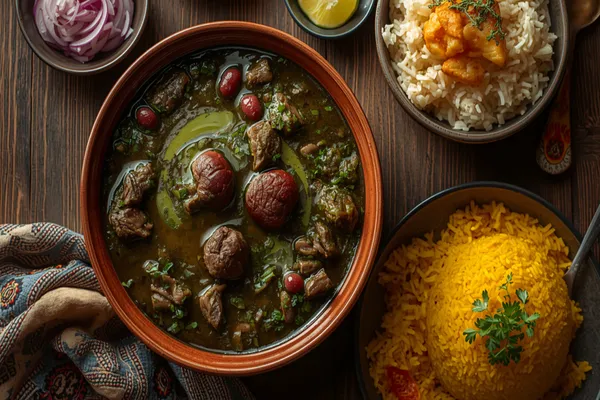
Ghormeh Sabzi (Persian Herb Stew)
Iran's national stew — kilos of parsley, coriander and fenugreek fried down to a near-black green, simmered for hours with lamb, red kidney beans and dried Persian limes until the whole pot turns deep, sour and unmistakably Persian.
The Levant (Lebanon, Syria, Jordan, Palestine) · Middle Eastern
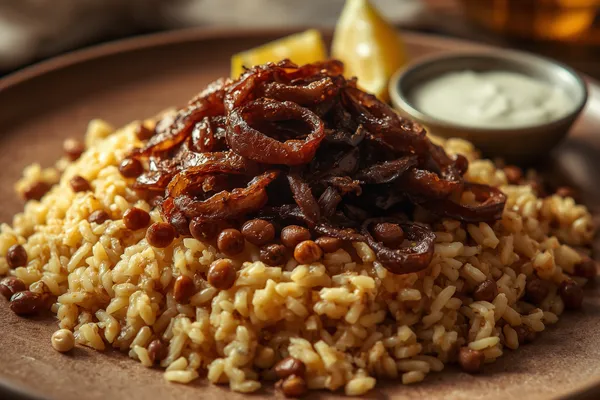
Mujaddara (Lentils and Rice with Crispy Caramelized Onions)
The Levantine dish of lentils, rice, and deeply caramelized onions — humble, ancient, and quietly luxurious. A handful of ingredients turned into something far greater than their cost, crowned with onions fried until almost black and sweet.
Egypt (Cairo) · Egyptian
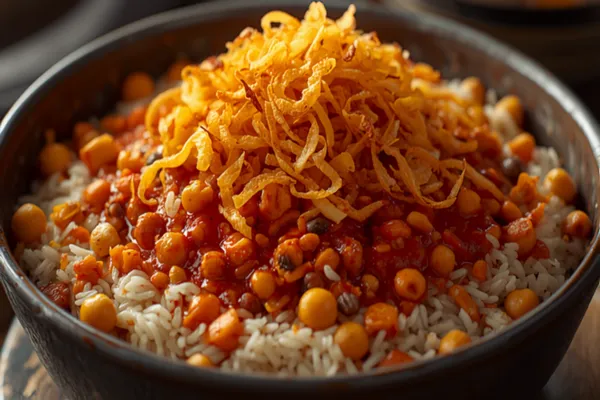
Koshari (Egyptian Rice, Lentils, Pasta and Crispy Onions)
Egypt's national dish and ultimate comfort food: a glorious carb-on-carb layering of rice, brown lentils and macaroni topped with chickpeas, a garlicky-spiced tomato sauce, a sharp vinegar daqqa, and a mountain of crispy fried onions.
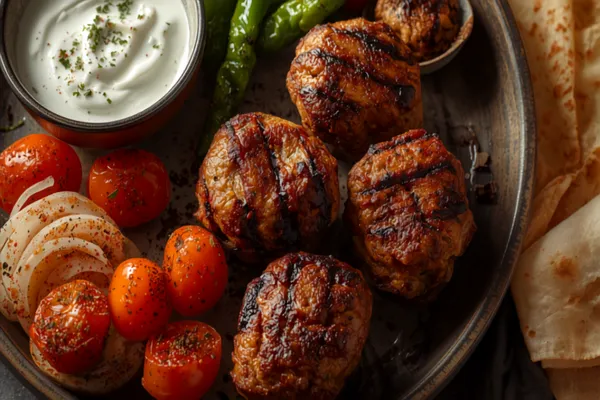
Turkey (pan-Turkish) · Turkish
Turkish Köfte (Spiced Grilled Meatballs)
Turkey's everyday favourite: ground meat kneaded with onion, garlic and cumin, shaped into little ovals and grilled or pan-fried until charred outside and juicy within. Served with flatbread, grilled peppers and a cooling salad.