Ghana, among the Akan peoples of the Ashanti, Akuapem, Akyem, Bono and Fante — and, under other names, throughout Nigeria, Ivory Coast, Sierra Leone, Cameroon, Angola and the Congo basin · Ghanaian & West African
Fufu — West Africa's Pounded Cassava & Plantain Swallow
Boiled cassava and green plantain pounded in a mortar until every lump disappears, into the smooth, stretchy dough West and Central Africa tears off by hand and dips into soup. No pineapple, no shortcuts — just the technique that makes fufu fufu.
Published September 24, 2026
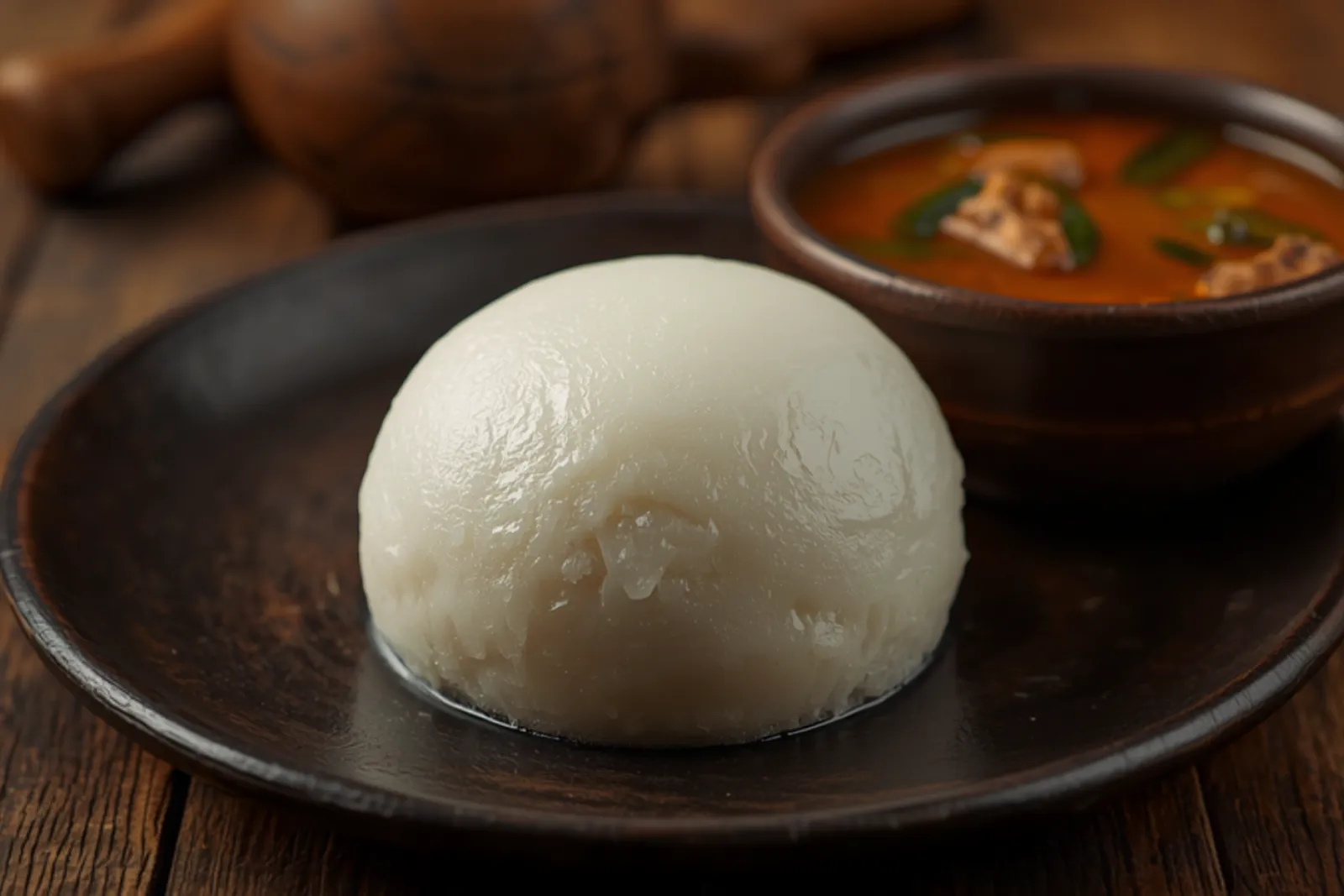
Cultural context
The word fufu comes from the Twi fufuo, meaning roughly 'white' or 'soft' — a description of the pounded dough itself. Ghana's Akan cooks were making it from cocoyam, plantain and yam long before cassava reached West Africa; Portuguese traders brought the root from Brazil in the 16th century, and it took over as the region's everyday starch because it grows almost anywhere and yields more food per acre than the crops it replaced. The same pounded swallow travels under a dozen local names — foutou in Ivory Coast, akpu in parts of Nigeria, funge in Angola — and belongs to no single country.
Fufu is the pounded, stretchy dough that West and Central Africa eats its soup with: cassava and green plantain, boiled until they give way completely, then beaten in a mortar until every lump disappears into one smooth, glossy mass. It sounds simple — two vegetables and water — and that simplicity is exactly the point. Fufu isn’t seasoned and it isn’t the star of the meal; it’s the utensil, the thing your hand tears a piece from to scoop up whatever soup is sitting next to it, and West African households will tell you, at some length, whose fufu technique is correct.
A Ghanaian staple that outgrew Ghana
Fufu began among the Akan peoples of what is now Ghana — the Ashanti, Akuapem, Akyem, Bono and Fante — who were pounding cocoyam, plantain and yam into a swallow long before cassava existed anywhere in Africa. Portuguese traders carried cassava across the Atlantic from Brazil in the 1500s, and within a couple of centuries it had become West Africa’s dominant starch. Cassava tolerates poor soil, drought and neglect better than almost anything else you could plant, and it produces more food per acre than the yam and cocoyam it largely displaced. Fufu rode that shift: the technique stayed the same, the ingredient underneath it changed. Today the same pounded dough is eaten from Senegal to the Congo basin under names that have nothing to do with each other — foutou in Ivory Coast, akpu in parts of Nigeria, funge in Angola — which is the clearest sign that this is regional food, not one country’s invention.
Why it has to be pounded hot
The single detail that separates good fufu from a lumpy imitation is temperature: cassava starch gels as it cooks and starts setting up again within minutes of coming off the heat, so the pounding — or its modern stand-in, the food processor — has to happen while the cassava and plantain are still steaming. Wait too long and no amount of beating will dissolve the lumps that have already locked in. That’s also why the traditional method is a two-person job in most Ghanaian and Nigerian kitchens: one person strikes with the pestle while a second folds and turns the mass between blows, so every part of it passes under the pestle before it has a chance to cool and set.
The plantain is doing real work
It would be easy to assume the small amount of plantain in the pot is just flavor, but its role is textural: the plantain’s starch behaves differently from cassava’s as it’s pounded, and the combination is what gives fufu its characteristic stretch rather than a stiff, dense mouthful of pure cassava. Leave it out — as some Nigerian cooks do, especially when working with fermented cassava for akpu — and you get a heavier, more neutral swallow that some people prefer specifically because it holds its shape better against a thick soup.
Serve it warm, in a shallow bowl, right next to a ladle of egusi soup or a pot of jollof for the day the soup runs out. If you want the fuller West African table it comes from, start with waakye for breakfast and work your way to fufu by dinner.
Ingredients
For the fufu
- 1 kg (about 2 lb) cassava (yuca) root, peeled Fresh, firm and unblemished. Slice out the woody core as you cut it — cassava that's gone fibrous or grey-streaked won't pound smooth.
- 1 unripe green plantain, peeled and sliced into rounds Must be fully green and hard, not the yellow, sweet kind — a ripe plantain turns the dough sticky-sweet instead of stretchy.
- 1/2 tsp fine salt Optional. Many West African cooks leave the fufu itself unsalted, since the soup it's dipped into carries all the seasoning.
- Water, for boiling and for wetting your hands
- 2 1/2 cups boiling water
Weeknight shortcut (optional — see Variations)
- 2 cups instant fufu or cassava swallow flour Sold at West African and Caribbean grocers; skips the fresh root entirely.
Method
Tap a step’s number to check it off as you go.
-
Cut the peeled cassava into 2-inch chunks, slicing out and discarding the tough fibrous core that runs through the centre of each piece.
Why: That woody core never softens no matter how long you boil it, and even one strand left in shows up as grit in the finished paste.
-
Put the cassava and sliced plantain in a large pot, cover with water by 2 inches, add the salt if using, and bring to a boil. Cook 25–35 minutes, until a knife slides through the cassava with zero resistance.
Why: Fufu is only as smooth as the starch is cooked. Any firmness left in the root becomes a lump that pounding alone can't fix.
-
Drain thoroughly, reserving about 1 cup of the cooking water. While everything is still hot, transfer it to a large mortar (or the bowl of a stand mixer fitted with the paddle, or a heavy-duty food processor).
Why: Fufu has to be pounded while hot — cassava starch sets up within minutes of cooling, and a dough that's gone cold won't take on the stretchy, elastic texture that defines it.
-
Pound with the pestle — or process in short pulses — turning and folding the mass back on itself constantly, and working in the reserved cooking water a tablespoon at a time, until it's one smooth, glossy, lump-free dough with no dry patches left.
Why: In a Ghanaian or Nigerian kitchen this is a two-person job: one person pounds while a second turns the mass between strikes so every part passes under the pestle. That constant turning is what makes fufu uniformly smooth instead of a paste with unpounded chunks still hiding in it.
-
Wet your hands with cold water and shape the warm dough into 4 rounded balls, smoothing the surface of each between damp palms.
Why: Wet hands keep the sticky starch from grabbing your skin, and they're what gives a good fufu ball its glossy, crack-free surface.
-
Serve immediately in a shallow bowl next to a ladle of soup, or keep it submerged in warm water if it has to wait.
Why: Fufu skins over and firms up fast once it's exposed to air; holding it under water (or under a tight lid) keeps it warm and soft until the soup is ready.
A quick, anonymous tap — no review needed.
Variations
- Weeknight cassava-flour version
Off the heat, whisk 2 1/2 cups boiling water into 2 cups instant fufu (cassava swallow) flour, then knead and fold it right in the pot with a wet spatula until smooth and elastic. It's the pantry shortcut most West African households abroad actually reach for on a weeknight.
- All-cassava, no plantain
Skip the plantain and pound cassava alone for the denser, more neutral swallow common in parts of Nigeria — sometimes made from fermented cassava and called akpu.
- Yam fufu
Swap the cassava and plantain for boiled white yam, pounded the same way, for fufu's best-known cousin: pounded yam, firmer and starchier, and just as classic a partner for egusi soup.
Serving & Storage
Pull off a golf-ball-sized piece with your right hand, press a thumbprint into it to make a small well, and use it to scoop up soup and its solids. Traditionally it's swallowed with little or no chewing, so the smooth dough carries the broth's flavor rather than competing with it.
Pairs with: Egusi Soup, Palm nut soup, Light soup, Groundnut (peanut) stew.
Storage: Best eaten warm, the day it's made — fufu firms and turns starchy-tight as it cools. Leftovers keep 2 days refrigerated, wrapped tightly; steam or microwave with a splash of water and re-knead briefly to restore the stretch before serving.
Nutrition
Per serving (1 ball (about 200 g))
- Calories
- 320
- Protein
- 2 g
- Carbs
- 77 g
- Fat
- 0.6 g
- Fiber
- 3.6 g
- Sugar
- 3 g
- Sodium
- 5 mg
Notable micronutrients: Vitamin C, Potassium, Manganese
Estimated using standard ingredient data. Values vary with brands and substitutions.
Frequently Asked Questions
Do I need a mortar and pestle to make fufu?
No. A stand mixer with the paddle (or dough hook), or short pulses in a heavy food processor, gets you most of the way there, and it's how plenty of home cooks — including West African cooks abroad — actually make it. You'll still want to fold it by hand at the end and check for lumps, which the mortar's constant turning otherwise does for you.
What's the difference between fufu, pounded yam, garri and ugali?
They're cousins, not the same dish. Pounded yam is fufu made from yam alone, especially popular in Nigeria. Garri (used to make eba) is cassava that's been grated, fermented and dry-roasted into granules, then simply stirred into hot water — no boiling of a fresh root and no pounding at all. Ugali is East Africa's dish: a stiff maize or sorghum porridge that's stirred, not pounded, and it doesn't have fufu's stretch. All four are eaten the same way — torn off in small pieces and used to scoop up soup.
Why is my fufu still lumpy?
Almost always undercooked starch: if a piece of cassava still has any bite left in it, no amount of pounding will smooth it out, so boil until a knife meets zero resistance. The second most common cause is letting it cool before pounding — cassava starch firms up within minutes, so work while everything is still hot.
What to drink with this
All drinks →Hand-picked pours to match this dish. Alcoholic pairings are for adults of legal drinking age (21+ in the US) — please drink responsibly.

Pan-Indian (the everyday tea of the subcontinent) · Indian
Masala Chai (Spiced Indian Tea)
India's daily ritual in a cup: black tea brewed with milk, sugar and freshly crushed spices. The proper stovetop method, plus how to build your own masala.

Mexico (agua fresca tradition) · Mexican
Agua de Jamaica (Hibiscus Iced Tea)
Mexico's ruby-red hibiscus cooler: dried jamaica flowers steeped, sweetened and chilled into a tart, refreshing agua fresca. The right steep, how to control the tartness, and why it's so good for you.
 21+
21+ Florence, Italy (Tuscan aperitivo tradition) · Italian
Negroni (The Perfect Three-Part Aperitivo)
Equal parts gin, Campari and sweet vermouth, stirred over ice with an orange peel. Italy's great bitter aperitivo — the easiest world-class cocktail to remember and one of the hardest to improve on.
From our kitchen community
Ratings & Reviews
My Rating
Tap a star to rate — no sign-in, no form needed.
My Review
0 Ratings
🥣 0 home cooks made it!
Be the first to rate Fufu — West Africa's Pounded Cassava & Plantain Swallow.
Related Recipes
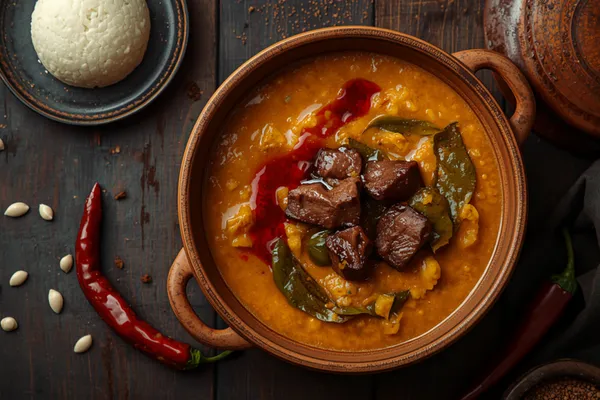
Southern Nigeria — Yorubaland in the south-west and Igboland in the south-east — and, under other names, across Ghana, Benin, Togo, Cameroon and the Congo basin · Nigerian & West African
Egusi Soup — Nigeria's Melon-Seed Stew, Fried in Red Palm Oil
Ground melon seeds fried in red palm oil until they break into soft golden curds, then simmered with stockfish, crayfish and fermented locust bean into the thick, savoury, oil-slicked stew that anchors the Nigerian table. Eaten with your hands, with pounded yam or eba.

Lagos and south-western Nigeria — part of the wider West African jollof belt · Nigerian
Jollof Rice (Nigerian Party Style)
West Africa's great one-pot rice, cooked the Lagos party way: a long-fried pepper-and-tomato base, parboiled long-grain rice steamed until every grain is stained red, and a deliberately toasted bottom pot for that smoky finish.

Northern Ghana — Dagbon and the Hausa zongo quarters, now sold at every roadside in Accra and Kumasi · Ghanaian
Waakye (Ghanaian Rice and Beans with Sorghum Leaves)
Ghana's great breakfast: long-grain rice and black-eyed peas simmered with dried red sorghum leaf sheaths until every grain turns burgundy, then loaded with shito, gari, talia and a boiled egg the way the roadside sellers of Accra do it.

Casamance, southern Senegal — the Jola country below the Gambia river, and across the borders into the Gambia and Guinea-Bissau · Senegalese & Gambian
Chicken Yassa (Poulet Yassa) — Casamance's Lemon and Onion Braise
More onion than chicken, by weight — that is not a mistake, it is the recipe. Casamance's poulet yassa marinates chicken overnight in lemon, mustard and a mountain of sliced onions, chars it over fire, then braises it back down into a jammy, sour-sweet sauce.
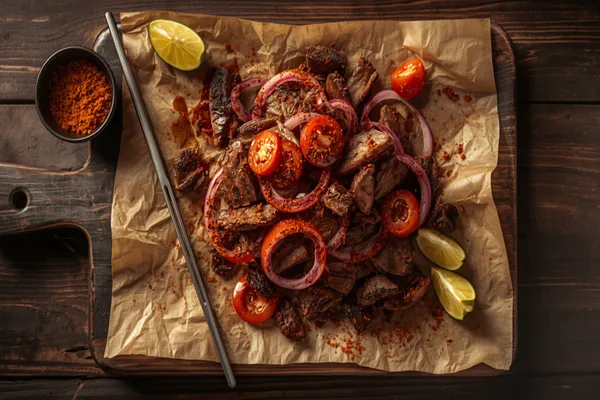
Hausaland — northern Nigeria (Kano, Zaria, Sokoto) and across the Sahel into Niger, Chad and northern Cameroon · Nigerian
Suya (Tsire) — Hausa Grilled Beef Skewers with Yaji
Nigeria's great night-time street food: beef sliced paper-thin, oiled, buried twice in a dry peanut-and-chilli rub, and grilled fast over charcoal. The secret is that yaji is a dry rub, not a marinade — and that the peanut in it has had its oil pressed out.