Guangdong and the Pearl River Delta — the congee shops of Guangzhou, Shunde and Hong Kong, within a rice-porridge tradition shared across China and much of Asia · Chinese
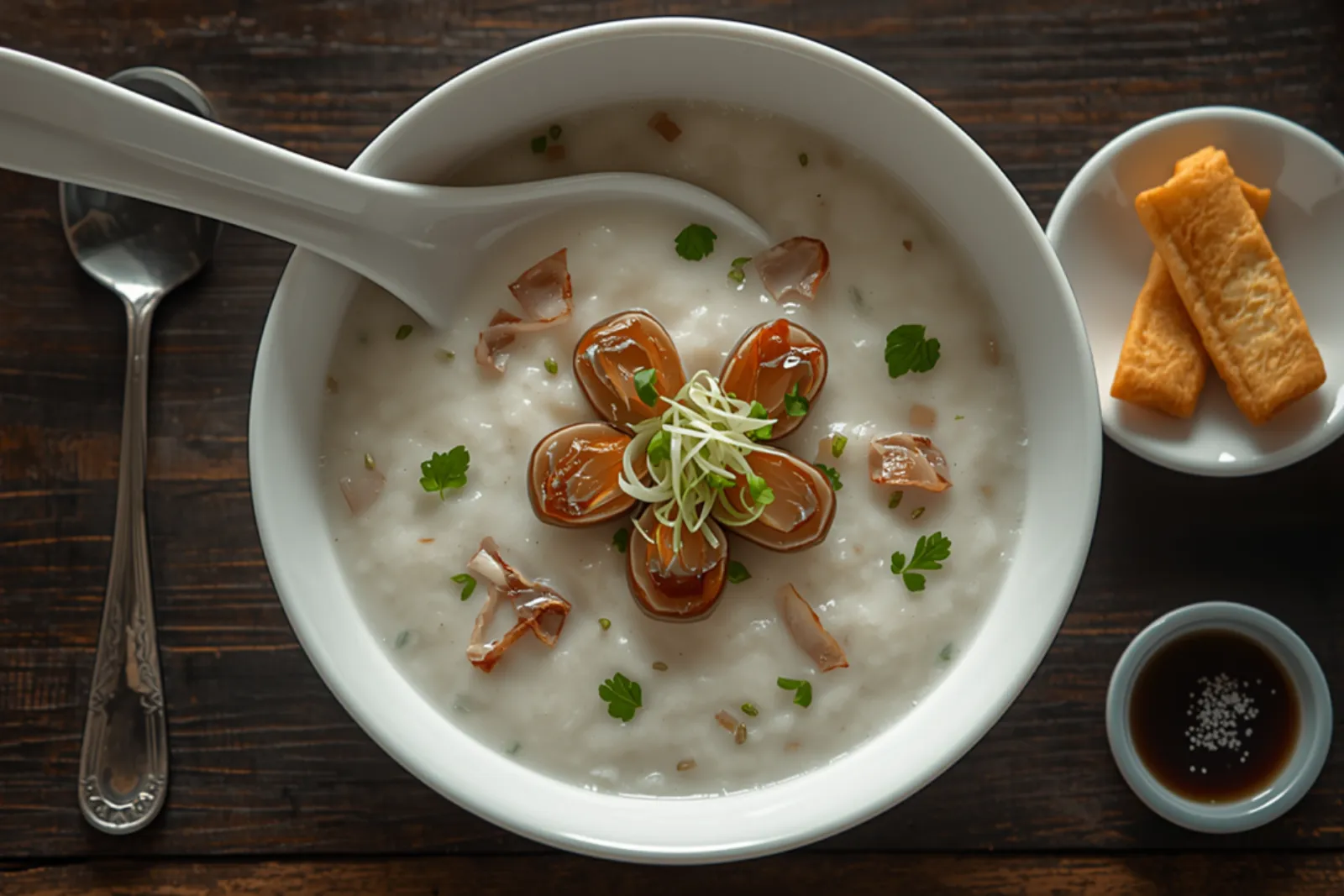
Congee with Century Egg and Pork (皮蛋瘦肉粥)
The Cantonese breakfast bowl the rest of the world learned to love: rice simmered in twelve times its weight in water until the grains vanish into something silky and savoury, finished with century egg, slippery pork and a snowfall of ginger and spring onion.
Published September 21, 2026
Cultural context
Rice porridge is one of the oldest cooked dishes anyone still eats: zhōu (粥) appears in Chinese texts from the Zhou dynasty and again in the Record of Rites, and versions of it are eaten from Kerala to Korea. The English word travelled separately — 'congee' comes from Tamil kanji, the water rice is boiled in, picked up by Portuguese and British traders in south India. What Guangdong contributed is a technique rather than an invention: Cantonese cooks simmer the rice until every grain dissolves, so the result is not rice in soup but a single smooth body, and they built a whole shop trade on it. Pei dan sau yuk juk (皮蛋瘦肉粥) — century egg and lean pork — is the bowl those shops are judged on, and it is what a Cantonese household makes for anyone who is unwell, hungover, very young, very old, or simply up before the rest of the house.
Congee is the oldest thing on most Chinese breakfast tables and the last thing anyone shows off about. Rice boiled in many times its weight of water until the grains give up and dissolve — zhōu (粥) in Mandarin, juk in Cantonese — appears in Chinese texts from the Zhou dynasty and in the Record of Rites, and some version of it is eaten from Kerala to Kyoto. The English word came a different way entirely: congee is Tamil kanji, the starchy water rice is boiled in, carried out of south India by Portuguese and then British traders and stuck onto a Chinese dish it never originally named.
What Guangdong added was rigour. A Cantonese congee is not rice in soup. It is one smooth substance, pale and glossy, with no visible grain left in it, and the bowl that shops are measured by is pei dan sau yuk juk (皮蛋瘦肉粥): century egg and lean pork.
The base is the dish
Everything that makes congee good happens before any topping goes near it. Three small decisions carry almost all of it.
Rinse the rice twice — no more. The instinct drilled into anyone who cooks rice is to wash until the water runs clear. Here that is the mistake. The cloudiness is surface starch, and surface starch is exactly what turns water into something creamy. Two rinses take off the dust and leave the rest.
Salt and oil the rice, then freeze it. Salting overnight seasons the grain from the inside rather than leaving salt sitting in the liquid, and a tablespoon of neutral oil coats each grain before it meets water, which is the unglamorous reason shop congee feels silky instead of pasty. The freezing is pure physics: the moisture inside the grain turns to ice, expands, and cracks the kernel open from within, so it falls apart in forty minutes instead of two hours. Cooks who prefer to soak the rice in the fridge overnight instead get a base at least as creamy; the traditional answer, of course, is simply to simmer for two hours and go do something else.
Boil hard, then barely simmer. Rice goes into water that is already at a rolling boil, never a cold start — cold-start grains sink and cement themselves to the pot. Ten minutes of violent boiling is doing mechanical work, smashing the fractured grains apart and keeping the starch in suspension. After that, high heat only scorches what has been released, so drop to the faintest simmer and stir up from the floor of the pot every few minutes.
Top up with boiling water, never cold
Congee is a starch suspension, and like any suspension it can be broken. A slug of cold water into a hot pot drops the temperature unevenly and splits it into thin liquid with heavy sludge beneath — and once split, it does not properly come back. Keep a kettle on.
Why the century egg goes in twice
Half the century egg goes into the pot early, chopped small, and half goes in at the very end. This is not fussiness; the two halves are doing different jobs.
The early half is chemistry. Century eggs are cured in a strongly alkaline mixture, and alkalinity speeds the breakdown of starch — the same effect that makes lye-water noodles slippery. Stirred in small, the pieces dissolve almost completely, deepening both the savour and the silkiness of the base. The late half is texture: glossy dark wedges with amber-jelly whites that you can still see in the bowl and bite into.
If the egg itself is the sticking point, it is worth knowing what it actually is. A pei dan is a duck egg cured a few weeks in salt, lime and ash — alkali doing without heat what a saucepan would do with it. The smell that alarms people is ammonia, and it burns off in a hot bowl within seconds.
Sang gun: cook the topping at the last minute
The pork goes in for four minutes, at the end, sliced thin and given a quick coat of cornflour and oil. Cantonese calls this sang gun (生滾), “raw-boiled”: congee shops keep a vat of plain base simmering all day and cook each order’s fish, pork, beef or offal to order in a single ladleful of it. It is why a bowl from a good shop tastes both long-cooked and fresh, and why pork simmered in from the start — grey, tight, flavourless — gets you neither.
The same logic runs through the garnish. Half the ginger simmers into the base; half is cut at the last second and scattered raw, because sliced ginger loses its top note within minutes. The lettuce goes into the bowl cold and gets the boiling congee poured over it, which wilts it exactly enough. And the white pepper — white, not black — is what makes the bowl taste Cantonese rather than merely mild.
Serve it far too hot, with youtiao torn over the top or a plate of cong you bing on the side, and a pot of Hong Kong milk tea. There is more on the world’s great everyday dishes in the world classics guide.
Ingredients
For the congee base (start the night before)
- 200 g (1 cup) jasmine or other long-grain white rice Jasmine is the Cantonese default: it breaks down readily and tastes of very little, which is the point. Short-grain rice gives a thicker, stickier porridge — use 10% less, or 10% more water.
- 1 tsp fine salt
- 1 tbsp neutral oil Groundnut, sunflower or rice bran. It coats the grains before they ever meet water and is the quiet reason shop congee feels glossy rather than gluey.
- 2.5 litres water, or half water and half unsalted chicken stock Twelve to thirteen parts liquid to one part rice by weight. Congee shops use plain water and build flavour from what goes in later; stock makes a richer bowl and is entirely acceptable at home.
- 1 sheet dried beancurd skin (fu zhuk), broken up — optional A Shunde congee-shop trick. It melts completely and gives the base a faint soy sweetness and extra body. Two dried scallops, torn into threads, do a similar job with more savour.
For the pork
- 300 g pork loin or lean shoulder, sliced 3 mm thick against the grain Lean is deliberate — sau yuk (瘦肉) means lean meat. Fatty cuts leave a slick on the surface of a pale porridge.
- 1/2 tsp fine salt
- 1 tsp cornflour (cornstarch)
- 1 tsp oyster sauce Optional but traditional. Leave it out and add a further pinch of salt if you want the bowl strictly pork-and-rice.
- 1 tsp neutral oil
- 1/8 tsp ground white pepper
To finish
- 2 century eggs (皮蛋), peeled and cut into eighths Sold in every Chinese grocery, usually preserved duck eggs with an amber-jelly white and a dark, creamy, faintly sulphurous yolk. Look for ones with no cracks. Rinse them after peeling; a quick 5-minute steam firms the yolk and makes them far easier to cut cleanly.
- 1 salted duck egg, hard-boiled, peeled and diced — optional Adds a bright orange, salty crumble against the dark century egg. If you use one, cut the salt elsewhere.
- 30 g fresh ginger, cut into very fine julienne Cut it just before serving. Ginger loses its top note within minutes of being sliced, and half of it goes in raw as a garnish.
- 3 spring onions, sliced into thin rings
- 1 tbsp light soy sauce
- 1/2 tsp toasted sesame oil
- 1/2 tsp ground white pepper, plus more at the table White pepper, not black. Its musty heat is part of the flavour signature of a Cantonese congee and black pepper reads as simply wrong here.
- A small handful coriander leaves, roughly torn
- 2 leaves iceberg or romaine lettuce, shredded — optional
- 1–2 youtiao (Chinese fried dough sticks), snipped into 2 cm lengths — optional The classic partner. Buy them from a Chinese bakery, refresh in a hot oven for 4 minutes, and dunk.
Method
Tap a step’s number to check it off as you go.
-
The night before: rinse the rice in cold water exactly twice, swirling with your hand, and drain well. Toss it with the salt and oil until every grain is coated, seal it in a freezer bag or box, and freeze for at least 8 hours.
Why: Three things are happening. Rinsing twice washes off dust but deliberately leaves the surface starch, which is what makes congee creamy — rinse until the water runs clear and you have thrown away the dish. The salt seasons the grain from within rather than sitting on top. And freezing turns the moisture inside each grain to ice, which expands and fractures the kernel from the inside, so it collapses in forty minutes instead of the traditional two hours. If you would rather not freeze, see the FAQ.
-
In the morning, toss the sliced pork with the salt, cornflour, oyster sauce, oil and white pepper. Leave it in the fridge while the congee cooks.
Why: This is velveting, scaled down. The cornflour and oil form a thin film that holds moisture in slices of very lean pork that are about to be dropped into a boiling pot — without it they seize and go stringy in a minute.
-
Bring the water (and stock, and the beancurd skin or dried scallops if using) to a hard rolling boil in a large, heavy pot — at least 4 litres, because congee climbs.
Why: The rice must meet water that is already boiling. Rice started in cold water sinks, sits and welds itself to the base of the pot long before the liquid is hot enough to keep it moving.
-
Tip in the frozen rice straight from the freezer — no thawing — bring it back to a full boil and keep it there for 10 minutes, stirring often with a long-handled spoon. Watch it: this is the stage that boils over.
Why: A hard boil is a mechanical process, not just a hot one. The convection physically batters the fractured grains apart and keeps the released starch suspended in the water instead of settling into a scorching layer on the bottom.
-
Drop the heat to the barest simmer — the surface should shift rather than bubble — half-cover the pot, and cook for 25 minutes, stirring from the bottom every 5 minutes.
Why: Once the starch is out, high heat only burns it. A bare simmer lets the grains keep swelling and dissolving while you stir the thickening base off the floor of the pot, which is where congee always catches first.
-
Stir in half the century egg pieces, chopped small, and half the ginger. Cook for another 5 minutes.
Why: Century eggs are strongly alkaline, and alkalinity accelerates the breakdown of starch — the first half dissolves almost entirely, deepening both the savour and the silkiness. It is the same chemistry that makes lye-treated noodles slippery, working in your favour.
-
Judge the consistency. It should fall from the ladle in a soft ribbon that settles back into the surface, and coat the back of a spoon like single cream. If it is too thick, loosen it with boiling water only, a ladleful at a time.
Why: Cold water breaks the suspension and the congee splits into watery liquid with sludge underneath, the way a broken sauce separates. Once split it will not come back together properly.
-
Raise the heat to a gentle boil, slide in the marinated pork slice by slice so they don't clump, and cook for 4 minutes, until just opaque.
Why: This is sang gun (生滾) — 'raw-boiled' — the way Cantonese congee shops work. The base simmers all day and the toppings are cooked to order in a ladleful of it, so the meat is barely done and the congee picks up its flavour at the last moment. Pork cooked in from the start would be grey and the bowl would taste flat.
-
Turn off the heat. Stir in the remaining century egg, the salted egg if using, the soy sauce, sesame oil and white pepper, and let it stand for 30 seconds.
Why: The second half of the egg goes in late so it stays as glossy dark wedges you can see and bite — texture and drama, where the first half was flavour and chemistry. Thirty seconds off the heat is long enough for the seasoning to spread without the pieces melting.
-
Put a small nest of shredded lettuce, if using, in the bottom of each warm bowl and ladle the boiling congee straight over it. Top with the reserved raw ginger, spring onion, coriander and a snip of youtiao, and take more white pepper to the table.
Why: The heat of the congee wilts the lettuce just enough to take its raw edge off while keeping the crunch, which is exactly the contrast a smooth bowl needs. Raw ginger added at the end tastes nothing like ginger that has simmered for half an hour — sharp, floral, and cutting straight through the richness.
A quick, anonymous tap — no review needed.
Variations
- Fish slice congee (魚片粥)
The other great sang gun bowl. Swap the pork for 300 g of firm white fish — grass carp is traditional, sea bass or halibut excellent — sliced thin and tossed with a little salt, white pepper, oil and ginger juice. Slide it in off the heat and let the residual warmth cook it through in 2 minutes; fish boiled hard falls apart into threads.
- Chicken congee (生滾雞粥)
Use 300 g of boneless chicken thigh, sliced and marinated exactly as the pork. Better still, poach a whole leg in the base for the last 20 minutes, then shred it in — the bone gives the congee a body plain water can't.
- Vegetarian
Leave out the pork and oyster sauce and build savour into the base instead: dried shiitake, a piece of kombu and the beancurd skin, simmered from the start. Century eggs are themselves vegetarian, and they carry a meatless bowl surprisingly far. Finish with fried shallots for the fat the pork would have given.
- Teochew-style muay (糜)
The neighbouring Chaoshan tradition takes congee in the opposite direction: cooked only 20 minutes, so the grains stay whole and loose in clear, starchy water, and served plain with a spread of salty little side dishes rather than cooked with anything. Use 8 parts water to 1 of unfrozen rice and stop while you can still see the grains.
- Without century egg
It stops being pei dan sau yuk juk, but it is still a very good bowl. Add a teaspoon of finely chopped preserved mustard greens or a few threads of dried scallop with the pork to replace the savoury depth the egg was carrying.
- Slow cooker or pressure cooker
Unfrozen rice, 1:10 with water, 8 hours on low in a slow cooker — set it before bed and wake to a finished base, then do the pork and egg on the hob in 5 minutes. In an electric pressure cooker, 1:9 for 20 minutes at high pressure with a natural release; stir hard at the end, because pressure-cooked congee looks split until you do.
Serving & Storage
Congee is a breakfast, not a starter, and in Guangdong it arrives with things to dip and things to crunch: youtiao snipped over the top or torn and dunked, a plate of cheung fun (rice noodle rolls) with sweet soy, maybe a salted duck egg cut into quarters. Serve it very hot in deep bowls — it holds heat like lava and cools fast once spread thin — with a spoon rather than chopsticks, and put the white pepper, the soy and the extra raw ginger on the table so everyone seasons their own. A pot of strong jasmine or pu-erh on the side, and nothing else needs to happen before ten in the morning.
Pairs with: Youtiao (Chinese fried dough sticks), Cheung fun with sweet soy, Jasmine or pu-erh tea, Hong Kong milk tea, Blanched choy sum with oyster sauce.
Storage: The base keeps 4 days in the fridge and freezes for 3 months, and it is worth making a double batch of base alone — cook it through step 5, cool it fast and store it without the pork or egg. It sets almost solid when cold; reheat over low heat with a splash of boiling water, whisking as it loosens, then cook fresh toppings into it. A finished bowl also keeps 2 days, but the pork toughens and the century egg greys on reheating, which is the whole argument for storing the base separately. Never leave congee at room temperature for long: a thick, starchy, low-acid porridge is a comfortable place for bacteria, so cool it in a shallow tray and refrigerate within the hour.
Nutrition
Per serving (1 large bowl (of 4), without youtiao)
- Calories
- 340
- Protein
- 23 g
- Carbs
- 44 g
- Fat
- 8 g
- Fiber
- 1 g
- Sugar
- 1 g
- Sodium
- 920 mg
Notable micronutrients: Selenium, Niacin, Vitamin B12, Phosphorus, Thiamine
Estimated using standard ingredient data. Values vary with brands and substitutions.
Frequently Asked Questions
What is a century egg, and is it really a hundred years old?
No — usually a few weeks to a few months. A century egg (皮蛋, pei dan) is a duck or chicken egg cured in an alkaline mixture of salt, lime, ash and clay or rice husks for anywhere from 15 days to three months. The alkali denatures the proteins without heat, exactly as cooking would, turning the white into a translucent amber-to-black jelly and the yolk into a dark green, creamy centre. The smell is faintly ammoniac and sulphurous in the bowl and largely disappears in hot congee. Buy them from a Chinese grocery, choose eggs with intact shells, and rinse after peeling. Modern commercial production uses food-grade alkali rather than the lead oxide some traditional producers once added; reputable brands are labelled lead-free.
Do I have to freeze the rice overnight?
No, it is a shortcut, not a rule. Traditional Cantonese congee is simply simmered for 1.5 to 2 hours, and the flavour is marginally rounder for it. The middle option is to soak the rinsed rice in salted, oiled water in the fridge overnight and cook for about an hour — several cooks find this gives an even creamier base than freezing. Whichever route you take, the stages are the same: hard boil first, bare simmer after, stir from the bottom.
Why did my congee separate into water and sludge?
Almost always cold liquid, or too little stirring. Adding cold water to a hot, starch-suspended porridge shocks it apart much like breaking an emulsion, so top up only with boiling water. Under-stirring lets the heavy starch settle and scorch, which does the same thing from below. It can also separate as it sits in the bowl if it was under-cooked — grains that never fully dissolved release their water and float. Cook until you genuinely cannot see individual grains, and stir it back together before serving.
How thick should congee be?
Cantonese congee should pour but not run: a ladleful falls in a ribbon and merges back into the surface within a second or two. It thickens noticeably as it cools and again in the bowl, so pull it off the heat looking slightly looser than you want. Regional preference varies enormously — Teochew muay is nearly soup with whole grains, some Hong Kong shops serve it thick enough to stand a spoon in — so adjust with boiling water and stop where you like it.
Can I make congee from leftover cooked rice?
You can, and on a weekday morning you probably should — about 2 cups of cooked rice to 1.5 litres of water, simmered 25 to 30 minutes with regular stirring. It will not be quite the same: rice that has already cooked and cooled has retrograded starch and never fully dissolves, so the texture is slightly grainier and less glossy than congee built from raw rice. Breaking up the cold clumps before it goes in helps, as does a more aggressive stir at the end.
Is congee gluten-free?
The base is — it is rice and water. The seasonings are where gluten sneaks in: most light soy sauce and most oyster sauce contain wheat, so use tamari and a gluten-free oyster sauce or simply extra salt. Youtiao are wheat dough and are out. Century eggs and salted duck eggs are naturally gluten-free.
What to drink with this
All drinks →Hand-picked pours to match this dish.

Hong Kong (cha chaan teng tradition) · Hong Kong
Hong Kong Milk Tea (Silk-Stocking Milk Tea)
Strong black tea pulled through a cloth sieve and softened with evaporated and condensed milk — Hong Kong's smooth, full-bodied café classic. Bolder than English tea, silkier than coffee, hot or over ice.
Japan (the chado tea tradition of Kyoto and Uji, home of Japan's finest matcha) · Japanese
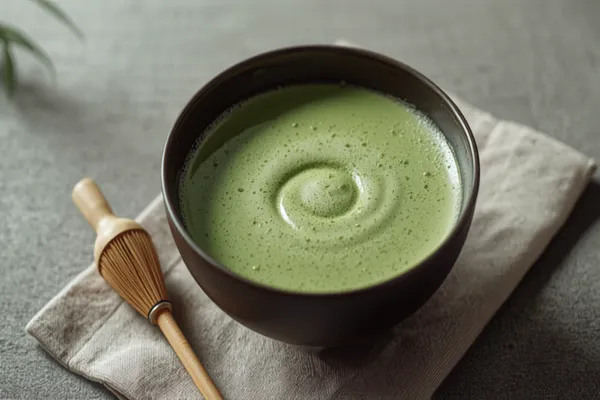
Matcha (Whisked Usucha, Thin Tea)
How to whisk a proper bowl of usucha — thin matcha — with a bamboo chasen: bright, jade-green, frothed to a fine foam, and faintly sweet-bitter. The everyday face of Japan's centuries-old tea tradition, ready in two minutes on a home counter.
Japan (matcha tradition, Uji & Nishio) · Japanese
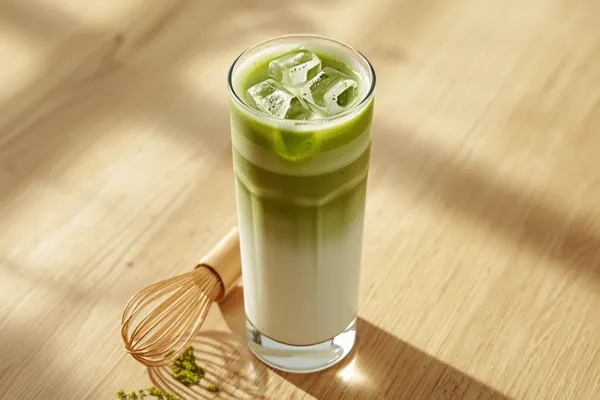
Matcha Latte (Whisked Japanese Green Tea Latte)
Stone-ground Japanese matcha whisked smooth and poured over steamed milk — grassy, sweet and gently caffeinated, with no bitterness when you make it right. A café favourite that's better and cheaper at home.
From our kitchen community
Ratings & Reviews
My Rating
Tap a star to rate — no sign-in, no form needed.
My Review
0 Ratings
🥣 0 home cooks made it!
Be the first to rate Congee with Century Egg and Pork (皮蛋瘦肉粥).
Related Recipes
Shanghai and the lower Yangtze, drawing on the northern wheat belt of Shandong and Henan where the bing tradition began · Chinese
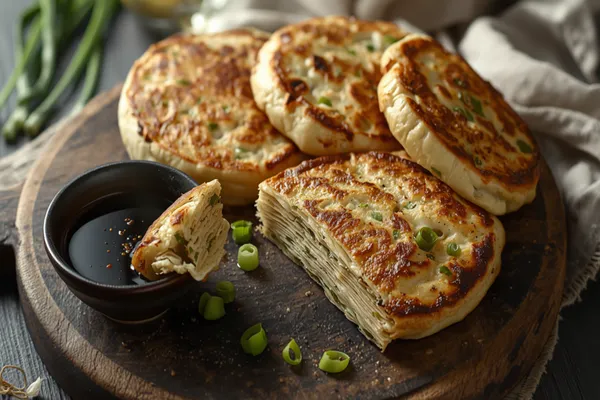
Cong You Bing — Chinese Scallion Pancakes with Shatteringly Flaky Layers
Flour, water, oil and spring onions, laminated like puff pastry and fried until the layers separate into flakes. The two things that decide the outcome are a half-boiling-water dough and an oil roux — not plain oil — between the sheets.
Guangzhou and the Pearl River Delta — the yum cha teahouses of Guangdong, and the dim sum halls of Hong Kong that carried them worldwide · Chinese
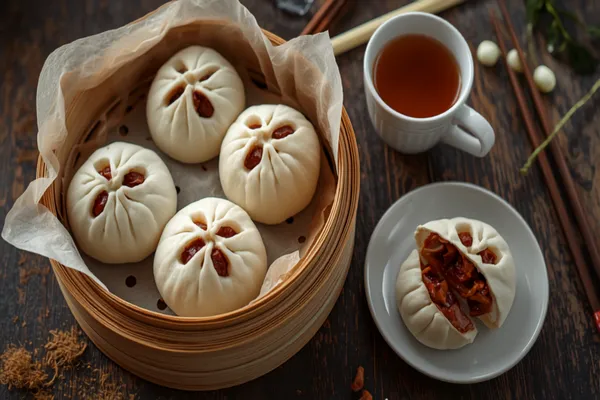
Char Siu Bao (Cantonese Steamed BBQ Pork Buns)
The cloud-white dim sum bun that splits open at the top like a laughing mouth: low-gluten dough steamed around a jellied sauce studded with sweet-savoury char siu. The filling is set firm on purpose — that is the whole trick.
Guangdong / Cantonese (China) · Chinese
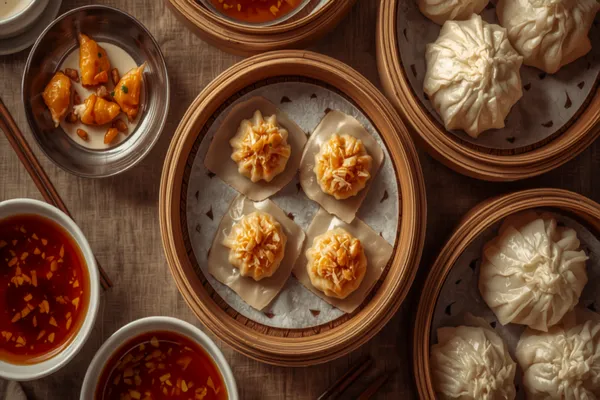
Siu Mai (Cantonese Pork and Shrimp Dumplings)
The open-topped dim sum classic — juicy pork and shrimp filling in a thin wheat wrapper, pleated into a little cup and steamed until plump. The dumpling at the heart of any dim sum spread, easier to make at home than you'd think.
Guangdong (Cantonese) · Chinese
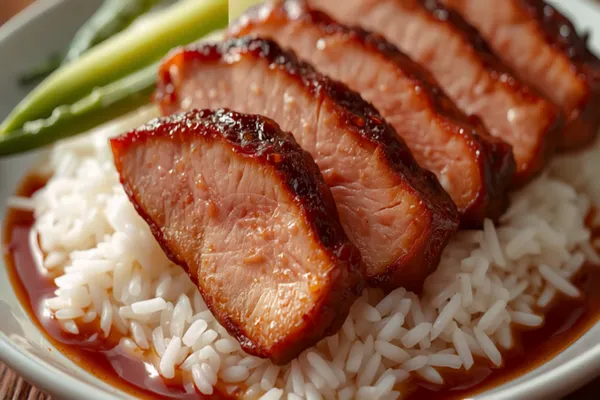
Char Siu (Cantonese Barbecue Pork)
The lacquered red-edged pork that hangs in every Cantonese roast-meat window: pork shoulder marinated in a sweet-savoury glaze of hoisin, soy, honey, and five-spice, then roasted and basted until sticky and caramelised. Easier at home than you'd think.
Hong Kong (cha chaan teng tradition) · Hong Kong
Hong Kong Milk Tea (Silk-Stocking Milk Tea)
Strong black tea pulled through a cloth sieve and softened with evaporated and condensed milk — Hong Kong's smooth, full-bodied café classic. Bolder than English tea, silkier than coffee, hot or over ice.
Singapore & Malaysia (Hainanese diaspora) / Southeast Asia · Singaporean & Malaysian
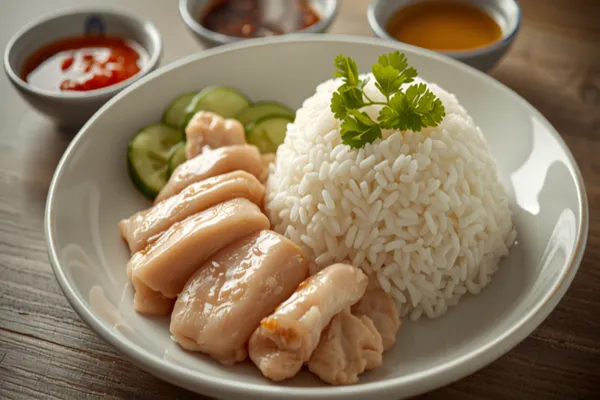
Hainanese Chicken Rice
The hawker-stall masterpiece of Singapore and Malaysia: a whole chicken gently poached to silky tenderness, rice cooked in the schmaltz-rich broth, served with a trio of sauces. Deceptively plain, ruthlessly precise, and one of the world's great comfort dishes.